
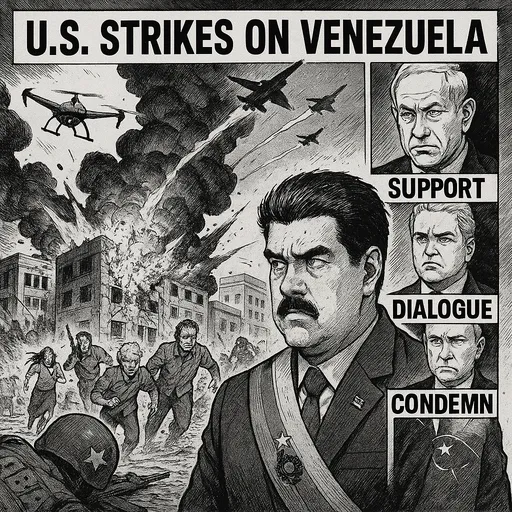
The United States launched significant military strikes on Venezuela targeting President Nicolás Maduro's regime, resulting in numerous casualties including Venezuelan civilians and Cuban military personnel. The operation, reportedly planned over several months, involved advanced drone technology and large-scale air assaults, leading to widespread destruction and heightened instability. International reactions are deeply divided: while some countries and leaders condemn the US actions as violations of sovereignty and international law, others, including Israel, support the intervention as a stand against dictatorship. Regional actors like Colombia and CARICOM call for diplomatic dialogue to prevent further escalation, while global powers such as Russia and China criticize the US move, warning of broader geopolitical consequences. The crisis has prompted urgent UN Security Council meetings and widespread calls for de-escalation amid fears of a growing humanitarian and geopolitical crisis.
This cluster reflects the viewpoint supporting or explaining the US military actions against Venezuela. Articles emphasize the strategic planning behind the strikes, the use of advanced military technology, and the objective to remove Nicolás Maduro from power. Some sources highlight the operation as a justified effort against a dictatorial regime and a necessary step to restore stability and counter foreign influence in the region. The US and allied voices frame the intervention as a decisive action amid ongoing political and security concerns.
This group includes articles from Venezuelan, Cuban, and regional perspectives condemning the US strikes as violations of sovereignty and international law. They report significant civilian and military casualties, including the deaths of Cuban nationals, and describe the attacks as criminal aggression that destabilizes Latin America. Regional organizations and countries express concern over humanitarian impacts and call for peaceful dialogue and respect for Venezuela's territorial integrity. The narrative stresses the human cost and the risks of escalating conflict in the region.
This cluster gathers international responses emphasizing diplomatic solutions, respect for international law, and calls to avoid further escalation. It includes statements from the UN, EU, African Union, and various governments urging restraint and peaceful resolution. Some articles analyze the broader geopolitical implications, including tensions between the US, China, and Russia, and the potential ripple effects on global security. The focus is on managing the crisis through dialogue and multilateral engagement to prevent wider instability.
This cluster highlights domestic and international criticism of the US military intervention in Venezuela. It includes voices like Senator Bernie Sanders and former French Prime Minister Dominique de Villepin condemning the strikes as reckless and harmful to peace. Some European political groups and analysts question the legality and strategic wisdom of the operation, reflecting concerns about the US foreign policy approach and its consequences for regional and global stability. These perspectives call for diplomatic engagement rather than military action.