
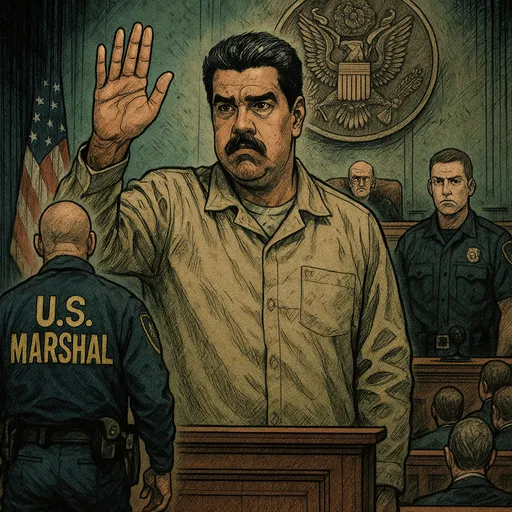
Venezuelan President Nicolás Maduro appeared in a New York federal court following his capture by US forces, pleading not guilty to serious charges including drug trafficking, narcoterrorism, and illegal arms possession. Maduro consistently denies all accusations, asserting his innocence and legitimacy as Venezuela's president, often describing himself as a prisoner of war or kidnapped. The trial has sparked significant international attention, highlighting geopolitical tensions between the US and Venezuela, with debates over legal jurisdiction and the legitimacy of prosecuting a sitting or former head of state. Security measures, courtroom incidents, and diplomatic reactions, including UN condemnations and US political statements, underscore the case's complexity and its broader implications for regional stability. The proceedings are expected to continue with further hearings scheduled, reflecting a protracted legal and political battle.
Articles from countries like the United States, Canada, the United Kingdom, and European nations focus on the legal aspects of Maduro's trial, emphasizing the charges against him, the court procedures, and the role of the US judiciary. They highlight the seriousness of the accusations, the involvement of experienced judges, and the security measures taken. These sources often frame the trial as a legitimate judicial process addressing criminal allegations and underscore the geopolitical significance of the case in US-Venezuela relations.
Articles from Venezuela and allied or sympathetic countries stress Maduro's claims of innocence, his assertion of being the legitimate president, and his characterization as a victim of US aggression, often describing his capture as a kidnapping or illegal act. These sources highlight Maduro's defiant statements in court, his self-identification as a prisoner of war, and the political motivations behind the charges. They also discuss the broader political crisis in Venezuela and the international diplomatic tensions arising from the trial.
Several articles from countries including the United Kingdom, Australia, Saudi Arabia, and others focus on the international diplomatic fallout from Maduro's trial and capture. They report on reactions from political leaders such as Donald Trump, UN Security Council debates, and statements from Venezuelan opposition figures. These sources emphasize the broader geopolitical implications, including US assertions of control over Venezuela, international condemnation of US military actions, and the impact on regional stability and international law.