
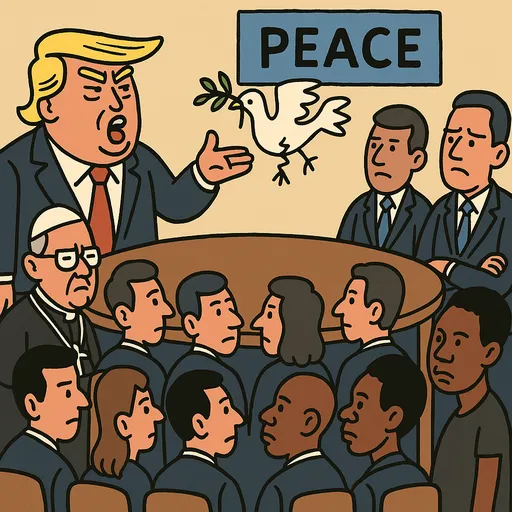
President Donald Trump launched a new Peace Council in Washington aiming to address international conflicts, with a particular focus on Gaza and broader peace initiatives. The inaugural meeting attracted participation from over 20 countries, with significant pledges for Gaza reconstruction and humanitarian aid. However, the initiative faced criticism and skepticism, notably from the Vatican and Austria, who declined participation citing concerns over undermining the United Nations and diplomatic legitimacy. African nations were notably excluded, raising concerns about their marginalization in global peace efforts. The council's future influence and effectiveness remain uncertain amid mixed international support and questions about its role relative to established institutions like the UN.
Countries such as Hungary and several others expressed support for the Peace Council, attending the inaugural meeting and endorsing its mission to promote international peace and diplomatic solutions. These nations view the council as a positive step towards addressing ongoing conflicts, including the Gaza situation, and emphasize multilateral cooperation under US leadership.
Austria and the Vatican declined to participate in the Peace Council, citing concerns about the initiative potentially undermining the United Nations and questioning its diplomatic legitimacy. The Vatican, through its top diplomats, emphasized preference for UN-led crisis management, reflecting skepticism about the council's approach and effectiveness. This stance highlights divisions within Europe and religious institutions regarding the new US-led peace effort.
African perspectives were notably absent from the Peace Council, with critiques focusing on the continent's exclusion from the board. This exclusion raises concerns about Africa's marginalization in global peace initiatives and the potential diplomatic repercussions. The viewpoint underscores ongoing challenges in ensuring inclusive international peace frameworks that represent diverse regional interests.
Several articles provide neutral or descriptive accounts of the Peace Council's inaugural meeting, outlining its goals to address international conflicts and promote peace without detailed critique or endorsement. These reports highlight the council's ambition to coordinate multinational efforts and the uncertainty surrounding its future impact and specific strategies.