
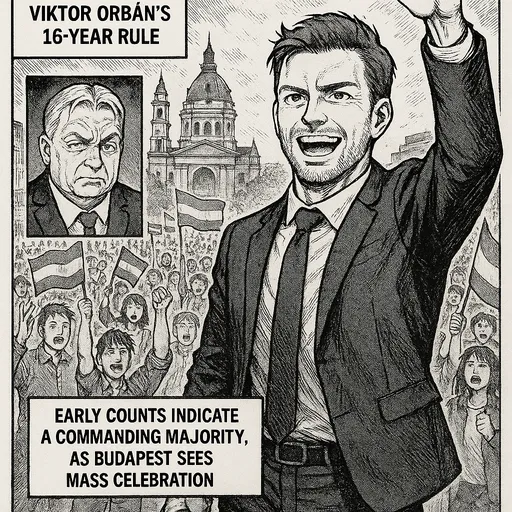
Péter Magyar’s opposition victory appears to end Viktor Orbán’s 16‑year rule, with early counts pointing to a commanding parliamentary majority and mass celebrations in Budapest. European leaders and EU institutions broadly welcomed the outcome as a pivot back toward Brussels and rule‑of‑law norms, while analysts and neighbouring capitals immediately assessed regional consequences. The incoming government faces major immediate tasks — tackling corruption, restoring legal and institutional checks, addressing economic grievances and healing deep domestic polarization. Neighbouring states and Kyiv are watching for shifts in Hungary’s foreign policy and potential changes to EU and NATO cooperation, even as a few contrarian and conspiratorial accounts circulated amid the post‑election noise.
This cluster groups outlets that frame Magyar's win primarily as a pro‑European pivot and a welcome restoration of ties with EU institutions. Coverage emphasizes congratulations from European capitals and international leaders and presents the result as a relief for Brussels and transatlantic partners.
These pieces highlight the emotional and historic character of the vote, portraying the result as the end of Orbán’s long tenure and a popular assertion of change. Reporting focuses on large street celebrations, the scale of the opposition victory and immediate political milestones such as seat counts and concessions.
This group focuses on the practical and institutional questions facing Magyar: anti‑corruption, rule‑of‑law restoration, constitutional issues and the difficulty of unifying a polarized country. Several pieces profile Magyar’s background and campaign methods while assessing policy priorities and the first tests for the new government.
Reports from Balkan and Central European outlets stress how Hungary’s change of leadership could reverberate across the region, from domestic governance models in the Balkans to Poland, Slovakia and questions over aid to Ukraine. Coverage frames the result as both an opportunity and a signal that neighbouring capitals will reassess policies and alliances.
A small set of reports diverge from the mainstream narrative, offering contradictory updates or conspiratorial attributions about who now holds power. These pieces represent outlier or uncertain perspectives amid the broad international consensus on the election outcome.