

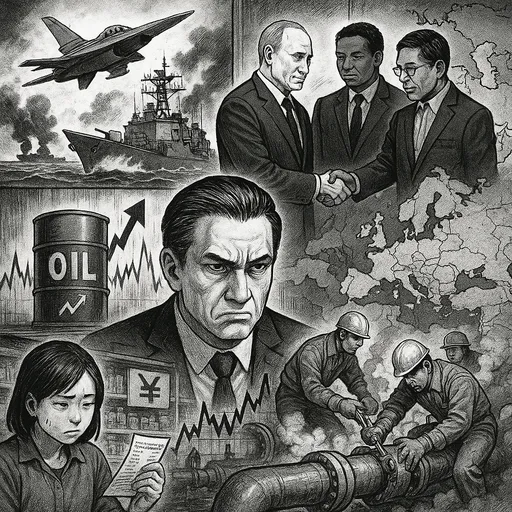
Rising tensions in and around the Persian Gulf, sanctions policy and pipeline disruptions are reshaping global energy flows and raising market volatility. Major powers are simultaneously tightening restrictions on rivals' oil sales while deepening bilateral energy ties — notably Moscow strengthening links with Asian, Caribbean and regional partners as importers seek alternative supplies. Import-dependent Asian economies and subsidy-dependent governments face inflationary and fiscal pressures, prompting diversification toward Russian crude and domestic measures to shield consumers. Europe is racing to repair pipelines and fill storage ahead of winter, underscoring strategic vulnerabilities in transit routes and infrastructure that influence aid and diplomacy. Overall, the crisis is accelerating both short‑term market dislocations and longer-term realignments in energy partnerships and supply corridors.
Jordanian authorities press for disclosure and accountability over contracts tied to the Wales gas project, highlighting domestic calls for transparency in energy procurement. The stance reflects concern about governance and investor confidence in energy investments.
A Western‑oriented report notes recent U.S. updates to sanctions on Russian oil but cautions that enforcement and market dynamics will limit near‑term impact. The perspective emphasizes skepticism about quick policy wins from sanctions alone.
Mexican reporting highlights Russia’s use of tankers to supply Cuba, framing Moscow’s shipments as mitigating Caracas’ and Havana’s shortages amid sanctions. The piece underscores how Russian logistics are sustaining clients outside traditional Western markets.
Mexican coverage relays U.S. President Trump urging the U.K. to exploit North Sea oil, reflecting a politicized push for greater domestic/external hydrocarbon production as an energy‑security response. The view frames greater drilling as a straightforward remedy to perceived supply gaps.
Chinese reporting questions whether the Philippines will prioritize near‑term energy stability over confrontational South China Sea policies, suggesting Manila faces a trade‑off under regional pressure. The perspective links energy needs to diplomatic choices in Asia.
Cambodian coverage emphasizes that threats of a U.S. blockade around the Strait of Hormuz have prompted crude to surge past $100 per barrel, highlighting market sensitivity to supply‑route risk. Traders and commentators underscore how military contingencies translate directly into price swings.
Lebanese reporting on Lavrov’s Beijing remarks highlights Moscow’s readiness to offset Chinese energy shortfalls caused by Middle East conflict, signaling deepening Russia–China energy cooperation. The perspective portrays Russia as a stabilizing alternate supplier to Asia amid regional shocks.
Japanese coverage frames talks between Russian and Indonesian leaders as an effort to expand strategic energy projects and partnerships, situating bilateral ties within broader regional security considerations. The view sees pragmatic economic collaboration continuing despite wider geopolitical tensions.
A Japan‑based business piece links Iran‑war related plastic shortages to accelerated adoption of eco‑friendly packaging by South Korean manufacturers. The perspective treats geopolitically driven supply disruption as a catalyst for sustainable industrial adaptation.
Japanese reporting relays a U.S. Treasury official’s criticism that China has behaved unreliably by accumulating oil stocks during conflict, framing Beijing as undermining alliance trust. The viewpoint emphasizes geopolitical frictions over energy security and cooperation.
Surinamese reporting highlights the country’s effort to market itself as carbon‑negative and to attract sustainable investment at IVECF 2026. The stance frames small producers as seeking leadership in the energy transition to gain diplomatic and economic leverage.
Moldovan reporting cites Bloomberg on a Chinese‑flagged tanker traversing and then reversing through the Strait of Hormuz, illustrating heightened attention to tanker movements in the chokepoint. The tone underscores uncertainty in shipping patterns amid regional tensions.
Reporting from Timor‑Leste notes Washington’s extension of narrow relief for transactions with Lukoil, portraying U.S. sanctions policy as calibrated and containing carve‑outs. The perspective highlights the complexity of enforcement versus economic considerations.
Vietnamese reporting relays World Bank revisions that attribute a growth downgrade for India to higher energy prices stemming from the West Asia crisis. The view links global conflict to concrete macroeconomic and fiscal consequences for large importers.
Hungarian reporting of Zelensky’s timeline for the Friendship (Druzhba) pipeline’s partial return underscores the strategic priority of restoring flows while acknowledging repair limitations. The perspective stresses how repairs affect regional energy resilience and reconstruction priorities.
Serbian coverage discusses routing Hungarian oil via Croatia instead of the Druzhba pipeline, illustrating intra‑European logistical adjustments to maintain supply. The viewpoint focuses on practical transit diversions to buffer against disruptions.
A Serbian brief reports that the United States will not renew authorization for selling Iranian oil, signaling continued U.S. pressure on Tehran’s exports. The piece frames the choice as part of sustained sanctions policy with global market implications.
Tajik reporting highlights South Korea’s $14 million investment to boost power access in Romit, framing donor cooperation as improving local energy reliability and development outcomes. The perspective presents overseas financing as supporting energy corridors and socio‑economic stability.
Swiss reporting connects potential EU aid to Ukraine with energy transit realities, suggesting pipeline repairs and Hungarian positioning could shape political bargaining over financial packages. The piece treats energy infrastructure as leverage in geopolitics and EU decision‑making.
Iraqi coverage stresses Iran’s port developments and foreign involvement as potential sources of disruption and risk for global oil markets. Analysts cited warn of altered maritime dynamics that could affect supply reliability and pricing.
Hong Kong reporting highlights Nomura’s finding that Japan and the Philippines are heavily reliant on Middle East crude, making them particularly exposed to any U.S.‑imposed Gulf blockade. The perspective foregrounds import dependence and regional vulnerability.
Danish reporting flags the completion reports of a contested pipeline, emphasizing geopolitical and economic debates over new transit infrastructure. The view underscores how pipeline projects remain focal points of regional contention.
Singaporean reporting describes Jakarta’s pivot toward Russian crude imports to reduce dependence on Middle East shipments and to relieve subsidy burdens. The stance illustrates pragmatic diversification by importers confronting price shocks and fiscal pressures.
Singaporean coverage conveys analyst expectations that Chinese growth will rebound early in 2026 even as the Iran war elevates global risks, suggesting reduced immediacy for stimulus. The perspective emphasizes China’s macro resilience amid external energy shocks.
Singaporean reporting details Malaysia’s rising RM7 billion fuel subsidy in April, framing the fiscal strain created by sustained low domestic fuel prices. The viewpoint highlights trade‑offs between social affordability and budgetary sustainability.
Singaporean reporting relays Janet Yellen’s warning that the conflict in Iran will add inflationary pressure globally through supply shocks, particularly in energy markets. The perspective frames the war’s macroeconomic implications as a policy challenge for advanced economies.
Singaporean business coverage shows how plastic shortages from the Iran war are accelerating demand for greener paper packaging in Asia, framing geopolitics as an accelerator of industrial substitution. The point highlights supply shocks fostering sustainable alternatives.
German reporting presents Australia’s push to diversify fuel supplies and strengthen Asian partnerships as a strategic response to risks from the Middle East and Ukraine. The perspective links alliance building to national energy resilience.
Macedonian reporting reiterates Ukraine’s announcement that the Friendship pipeline will be partially back by April’s end, noting implications for finance and energy security amid political bargaining. The view sees infrastructure restoration as entangled with broader aid negotiations.
Georgian reporting highlights a 14% year‑on‑year rise in Azerbaijani gas shipments to Georgia, framing the boost as strengthening regional energy cooperation and Georgia’s security. The perspective underscores the role of regional suppliers in stabilizing nearby markets.
Georgian coverage notes EU recognition of a high‑capacity submarine cable linking Georgia and Romania, framing it as strategic infrastructure that deepens Europe‑Caucasus connectivity. The view connects digital and energy/security collaboration under EU support.
Kosovar reporting covers Germany’s proposed $1.9 billion package to mitigate oil prices for consumers, portraying proactive national intervention to blunt energy cost shocks. The viewpoint highlights government fiscal measures to protect households.
Bahraini reporting emphasizes that the Iran conflict has forced the International Energy Agency to change market forecasts, reflecting the war’s material effect on supply‑demand expectations. The stance treats agency revisions as key guidance for policymakers and markets.
Brazilian reporting highlights Beijing’s raised rhetoric and promises of countermeasures in response to a U.S. blockade of the Strait of Hormuz, indicating a readiness to defend maritime and energy interests. The perspective frames the dispute as an emerging great‑power confrontation over sea lanes.
Brazilian coverage conveys expert assessments that Iran could withstand a U.S.‑led blockade for weeks or months, underscoring Tehran’s strategic resources and possible regional support. The view treats prolonged disruption as plausible with sizable global repercussions.
Guatemalan reporting summarizes a meeting between Venezuela’s vice‑president and a U.S. Department of Energy delegation, signaling ongoing bilateral engagement despite broader tensions. The piece frames the contact as pragmatic diplomacy on energy matters.
Israeli analysis links potential closures of the Strait of Hormuz to severe disruptions in the global fertilizer trade, warning of knock‑on consequences for food prices and security. The perspective stresses how energy‑route shocks cascade into other critical commodity markets.
Vanuatu reporting notes that Pacific island states plan to present a united front at international talks on fossil‑fuel phase‑out, emphasizing climate‑driven energy diplomacy from vulnerable small states. The view prioritizes transition demands in global negotiations.
Greek reporting describes Iran’s aviation fuel disruptions and flight cuts as having broader effects on connectivity and regional air travel markets. The perspective highlights operational and economic fallout for transport sectors.
Peruvian reporting covers Argentina’s congressional approval to allow mining in glacier regions, reflecting a development‑first stance at the expense of environmental objections. The piece situates resource extraction debates within domestic political shifts.
U.S. reporting analyzes how China has so far weathered the oil shock but is beginning to face higher costs and pressures ahead of high‑level talks with the United States. The perspective frames energy security as a central topic in great‑power diplomacy.
U.S. coverage presents economic estimates of the Iran war’s damage across Asia, stressing widespread costs from disrupted trade and energy markets. The viewpoint treats the conflict as having sizable negative macroeconomic consequences for regional growth.
U.S. reporting notes that Canada’s new government quickly suspended the fuel tax to blunt price shocks, signaling swift domestic policy to cushion consumers from the crisis. The perspective highlights fiscal tools used by advanced economies to address energy‑driven inflation.
Yemeni reporting covers record U.S. gas prices and their contribution to higher inflation, underlining domestic spillovers from global energy disruptions. The piece treats higher fuel costs as a key channel transmitting international risk to households.
Cuban reporting emphasizes Moscow’s cooperation with Havana on renewable‑energy projects, framing the partnership as part of long‑standing bilateral energy ties that now include clean‑energy dimensions. The view presents Russia as a partner across fossil and renewable sectors.
Dominican reporting from AFP underscores that the Iran conflict has begun to affect global markets and investor sentiment, amplifying uncertainty and price volatility. The view stresses early‑stage but tangible economic repercussions worldwide.
Azerbaijani reporting on BP’s new CEO frames the leadership transition as an effort to streamline the oil major’s corporate structure and improve efficiency. The perspective treats corporate governance changes as consequential for industry strategy amid turbulence.
Azerbaijani reporting relays U.S. claims that Iranian ports have seen a complete absence of shipping, reflecting heightened surveillance and concerns over maritime activity in the Strait of Hormuz. The piece underscores the monitoring dimension of maritime security.
Ecuadorian analysis frames Europe as facing a trade‑off between allied security commitments and pursuing autonomous energy diversification in response to the Strait of Hormuz crisis. The perspective calls for a more self‑reliant European approach to mitigate external shocks.
Gabonese analysis situates the Iran war’s global ripple effects as an impetus for rethinking diplomatic and energy strategies, urging diversified partnerships. The viewpoint stresses proactive national positioning amid shifting geopolitics.
Haitian reporting highlights ENTSOG’s warning to prioritize filling European gas storage ahead of winter, reflecting concern over low replenishment capacity and potential price volatility. The stance stresses urgency in preparedness for seasonal demand spikes.
Macanese reporting notes large U.S. banks’ profit gains and executives’ views that consumers are holding up despite oil price spikes, indicating near‑term financial resilience. The perspective suggests markets and lenders may absorb short‑run energy shocks.
Ukrainian reporting reports U.S. plans to restore sanctions on Russian oil and not renew a separate Iranian authorization, depicting a tightening of U.S. policy across multiple fronts. The viewpoint highlights coordinated sanctions actions affecting global supplies.
Tongan reporting conveys warnings from a Gulf billionaire about evolving conflict dynamics and economic risks, signaling concerns from regional private capital about instability. The perspective reflects how affluent regional actors gauge strategic trajectories.
Tongan analysis connects rising energy prices to economic and food‑security pressures for Pacific nations, recommending policy responses and strengthened partnerships. The view emphasizes vulnerability and need for resilience measures in small island states.
Tongan opinion argues that U.S. energy and foreign‑policy choices are repeating past errors, critiquing Washington’s strategic approach and its global consequences. The viewpoint is skeptical of current U.S. crisis management in the Middle East.
Chilean reporting reflects a U.S. Treasury claim that China has behaved unreliably regarding Iranian oil, highlighting mistrust in economic statecraft among major powers. The perspective frames energy access as a point of diplomatic contention.
Croatian reporting notes advocacy for stronger U.S. engagement in North Sea drilling, mirroring transatlantic debate on expanding hydrocarbon production for energy security. The stance favors increased upstream activity as a strategic choice.
Libyan reporting on a joint Libya–Algeria oil and gas find presents the discovery as a positive step for regional production and potential investment. The perspective highlights the ongoing significance of conventional upstream gains for regional energy prospects.
Panamanian coverage examines Beijing’s efforts to expand influence in polar areas for strategic, environmental and economic reasons, situating polar engagement within broader geostrategic competition. The viewpoint flags long‑term resource and access ambitions.
Egyptian reporting echoes economists’ assessments that the US‑Israel‑Iran war fallout could inflict heavy losses on Asia, emphasizing risks to trade, investment and growth. The perspective stresses the scale of potential regional economic damage.
Egyptian reporting reiterates that while China has managed the oil shock so far, rising costs are increasing pressure ahead of high‑level talks with the United States. The viewpoint treats energy disruption as a growing element in strategic dialogue.
Faroe Islands reporting notes that more than 20 ships passed through the Hormuz Strait, underlining that commercial transit persists despite elevated security risks. The piece highlights the mixed picture of continuing flows amid volatility.