
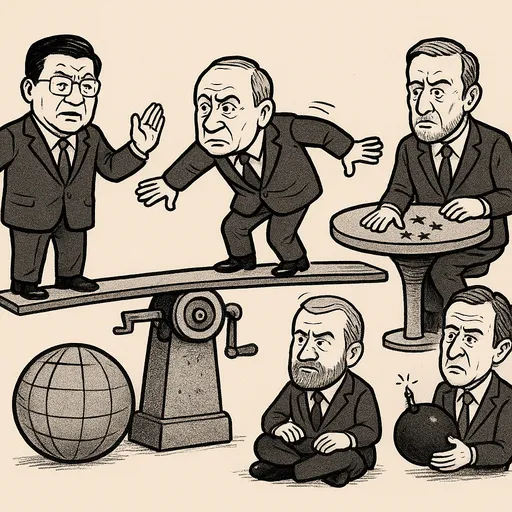
World leaders and senior officials are engaged in a wide range of bilateral and multilateral dialogues aimed at managing regional tensions, advancing economic integration, and exploring negotiated political transitions. China is actively promoting governance reforms, digital and media cooperation, and urging restraint in security hotspots, while Russia and its Eurasian partners emphasize deeper regional integration and assertive diplomatic postures. Western actors and the EU are recalibrating mediation roles—particularly on Ukraine—while the United States continues to broker or host talks in the Middle East, including Lebanon–Israel communications. Meanwhile, Latin American and Caribbean diplomacy focuses on political transitions and regional security cooperation, and Cuba repeatedly signals stalled negotiations with the United States and growing concerns about possible aggression.
Opposition figures in Venezuela present negotiation and internationally accompanied electoral processes as the preferred route to restore democratic governance, inviting outside support to legitimize transitions. They frame talks with the interim government as an alternative to unilateral power grabs and stress international observation.
China emphasizes multilateral governance reforms, digital cooperation, and media exchanges with the Global South while urging restraint to avoid provocative security moves in the Indo‑Pacific. Beijing frames its diplomacy as constructive leadership on AI, UN reform, regional trade and people‑to‑people ties, even as strategic competition with Western partners continues.
Russia and allied Eurasian states stress deeper economic integration, digitalization and institutional adaptation across the EAEU and CIS while maintaining a muscular diplomatic posture on security issues. Moscow’s leaders combine forum diplomacy, bilateral symbolism and firm messaging on geopolitical questions, reflecting a push to shape regional architectures.
Cuban officials repeatedly portray negotiations with the United States as stalled and warn of increasing risks from U.S. pressure or aggression, while defending multilateralism and protesting restrictive measures in international forums. Havana uses diplomatic venues to decry humanitarian and economic impacts and to call for accountability and respect for sovereignty.
Israel’s recent decisions to cut or restrict contact with the UN leadership signal a sharp diplomatic rupture rooted in disagreement over UN handling of conflict‑related allegations. The move reflects growing friction between Jerusalem and international institutions and raises questions about future cooperation and accountability mechanisms.
U.S.-hosted and regional talks aim to reduce military tensions—particularly between Lebanon and Israel—while separate diplomatic tracks address Iran, Gaza reconstruction and broader regional realignment. States and analysts remain cautious about whether provisional agreements or initiatives represent durable breakthroughs or temporary de‑escalation steps.
High‑level meetings between Pakistani and U.S. officials signal continued bilateral engagement on security, trade and regional issues, with Islamabad seeking to advance ties in Washington. Pakistani statements also reflect regional diplomatic sensitivities, including views on Korean‑peninsula engagement.
Turkmenistan is expanding its external engagement through meetings with Western counterparts and participation in international forums on regional issues like water security. The country presents a pragmatic, multilateral approach to build partnerships beyond its immediate neighborhood.
EU and Western actors are recalibrating mediation roles over Ukraine, balancing continued diplomatic presence with calls for unified strategies and explicit demands on Moscow. Some analysts argue that shifts in U.S. mediation posture create space for Kyiv to pursue alternative diplomatic options while the EU seeks to avoid being maneuvered by Russian tactics.
Leaders use international summits and expos to advance governance, development and cooperative agendas, signaling continuity of multilateral engagement despite geopolitical tensions. Participation ranges from World Government and trade expos to security dialogues that set agendas for regional cooperation.
India balances contested regional relationships—hosting Myanmar’s leader and managing maritime and consular incidents—while seeking to shape ties with neighbors through high‑level visits. These engagements reflect New Delhi’s pragmatic approach to complex regional politics.
Several South American governments are coordinating strategies to combat transnational organized crime, emphasizing shared mechanisms and regional collaboration. These initiatives underscore a collective interest in enhancing law enforcement cooperation across borders.
Voices from the Belarusian opposition and neighboring states debate the political choices surrounding engagement with Kyiv and Europe, questioning uncompromising stances and exploring the implications of high‑profile visits. The discourse reflects contested narratives about national strategy and external alignments.
Caribbean states and institutions are actively engaged in diplomatic exchanges and regional cooperation, from embassy responses to leadership of policing bodies and bilateral presidential meetings. This activity highlights sustained regional governance and security coordination.
Routine diplomatic courtesies, ceremonial audiences and state visits continue to form part of states’ soft‑power and relationship‑building efforts, signaling normal channels of engagement even amid geopolitical friction. Such events underline the role of protocol in sustaining ties.
Negotiations involving Greenland, Denmark and the United States, and political ambitions in the Faroe Islands, indicate evolving regional bargaining over strategic Arctic and North Atlantic interests. Local leadership stresses the potential to shape outcomes in broader international negotiations.
SIDS are asserting influence in global governance by championing ambitious climate action and driving UN resolutions, reflecting leadership on existential issues for vulnerable states. Their diplomatic push seeks stronger international commitments and accountability on climate policy.