
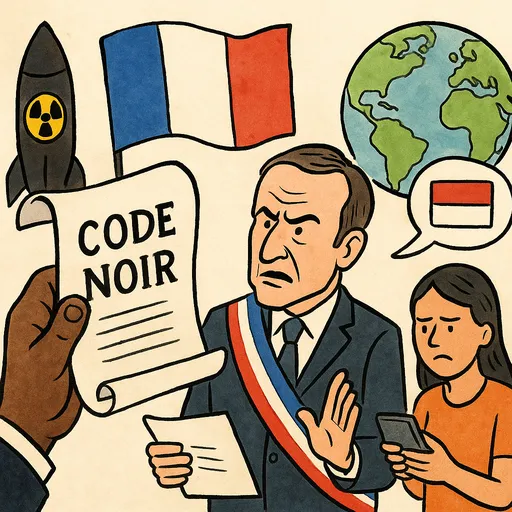
Recent developments in France highlight a dual focus on addressing historical injustices and expanding international cooperation. The unanimous abolition of the Code Noir by the National Assembly marks a significant symbolic step in confronting France's colonial past and slavery legacy. Concurrently, France is actively engaging in diplomatic and security initiatives, including extending nuclear deterrence to Norway, deepening ties with Indonesia, investigating the treatment of its nationals on a Gaza flotilla, and participating in global digital governance discussions. Domestic challenges such as a controversial conviction of a French scholar, concerns over press freedom, and social issues linked to social media violence also feature prominently, alongside environmental stresses from an ongoing heat wave.
This cluster centers on France's legislative and symbolic actions to confront its colonial past, particularly the unanimous parliamentary abolition of the Code Noir, a slavery-era legal framework. The articles emphasize the emotional and political significance of this repeal as a necessary legal and moral reckoning, with implications for reparations debates and national memory. The coverage reflects a broad consensus on the importance of addressing historical injustices and the enduring impact of colonial laws on contemporary society.
France is actively reinforcing its international security commitments and diplomatic relations, as seen in extending its nuclear umbrella to Norway and strengthening bilateral ties with Indonesia through defense and trade discussions. The dispatch of a crisis diplomat to Madagascar and adjustments in New Caledonia's electoral processes illustrate France's ongoing engagement with its overseas territories and former colonies. These actions demonstrate France's strategic positioning amid global uncertainties and its role within NATO and broader international frameworks.
France is pursuing accountability and justice in cases involving its nationals and public figures. The government has initiated investigations into the treatment of French activists aboard the Gaza flotilla, signaling a commitment to protecting citizens abroad and upholding international humanitarian norms. Domestically, the conviction of Islamologist François Burgat for glorifying terrorism highlights tensions in public discourse on extremism and academic freedom. Additionally, the trial of former President Nicolas Sarkozy for campaign financing underscores ongoing legal scrutiny of political figures.
Concerns about press freedom and the influence of social media are prominent in France's current social landscape. The case involving former RT France chief Xenia Fedorova raises questions about media independence amid geopolitical tensions. Meanwhile, a tragic incident involving a teenager's death linked to a TikTok rejection spotlights the real-world consequences of social media dynamics. These issues reflect broader debates on information freedom, media regulation, and the societal impact of digital platforms.
France is facing significant environmental challenges, notably an intense heat wave described as a heat dome, which affects public health and infrastructure. In parallel, regional connectivity improvements are underway, such as the authorization of Islandhopper flights between St. Eustatius and French Saint Martin, expected to boost tourism and commerce. These developments illustrate France's efforts to manage climate risks while enhancing economic integration in its territories and neighboring regions.
France hosted and participated in high-level international discussions on digital policy, including the G7 digital ministers meeting where common principles for protecting minors on social media were unveiled. These efforts aim to establish international guidelines on age verification, content moderation, and privacy protections, reflecting France's leadership role in shaping global digital governance and online safety standards.
France's influence in the Caribbean is evident through initiatives to strengthen trade ties, such as Saint Lucia's efforts to enhance access to EU markets via Martinique. These collaborations focus on improving market access, logistics, and standards, highlighting France's role as a gateway for regional economic integration and export opportunities within the European Union framework.
Economic challenges in French territories are exemplified by concerns in New Caledonia over rising kava prices, which threaten local businesses and consumer access. This situation underscores the territories' dependence on imports and the vulnerability of local industries to global price fluctuations, prompting stakeholders to monitor and address these economic pressures.