

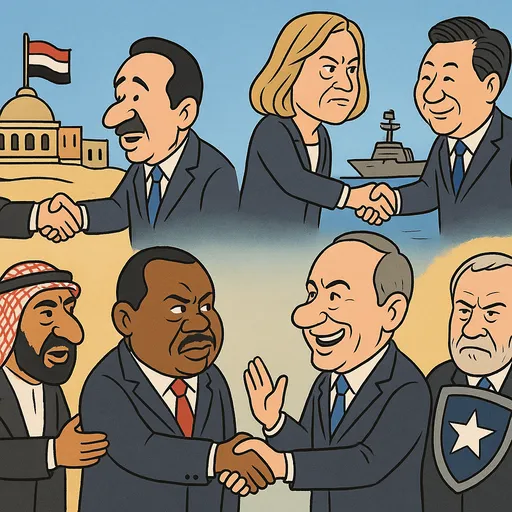
Across regions, states are advancing bilateral deals that range from infrastructure and investment pacts to defense and security cooperation. Economic diplomacy and investment guarantees feature heavily, with countries courting foreign partners for energy, mining and transport projects while development funds and visa arrangements are updated to facilitate official travel. Security cooperation and defence alignments—particularly in the Indo-Pacific, Mediterranean and Sahel—appear alongside thawing diplomatic relations and embassy reopenings. Parallel tracks of re-engagement are visible in the Middle East, where actors welcome steps to reintegrate Syria, and in the Pacific and Africa, where partnerships seek to strengthen capacity and resilience.
Several states and regional bodies welcome US steps to move Syria off the terrorism sponsors list and frame cultural returns and reconstruction as signals of reintegration. The perspective emphasizes opening economic channels and diplomatic engagement to support stability and reconstruction in Syria.
Libyan authorities and partners are pursuing investment, trade and energy development memoranda and agreements to rebuild and reopen sectors. The angle highlights efforts to attract Italian, Qatari and other foreign partners while boosting border and port cooperation with European counterparts.
Both countries present reciprocal and ceremonial diplomacy to deepen official ties, notably agreeing visa exemptions for diplomatic and service passports and exchanging condolences and high-level attendance. The view stresses small-state bilateralism focused on easier official travel and symbolic gestures.
Tensions over Greenland’s status and Arctic security measures surface alongside investments in maritime surveillance assets. Denmark stresses sovereignty while security actors debate strategic options involving the United States and broader defense cooperation.
Liberian leaders indicate a push to deepen ties with multiple partners, noting renewed Chinese health assistance, US development programming and outreach to Turkey for flights, investment and resident embassies. The position emphasizes diversification to accelerate development and connectivity.
India is broadening strategic and economic ties across the Indo-Pacific, signing or announcing partnerships on defense, uranium, and wider strategic cooperation with partners from New Zealand to Australia and Japan. The perspective frames these moves as part of India’s effort to diversify options and deepen regional influence amid shifting great-power dynamics.
Australia is strengthening its footprint in the Pacific via defense pacts, police training, development programs and trade initiatives to bolster regional partners and deter external influence. The emphasis is on capacity-building, security cooperation and economic linkages across Pacific island states.
China is portrayed as deepening bilateral ties through diplomatic endorsements and development projects, reaffirming support for strategic partners like North Korea and pursuing commercial and agricultural investment abroad. The stance highlights Beijing’s sustained regional outreach combining political backing and on-the-ground economic assistance.
Turkmenistan is engaging with the United States and neighboring Azerbaijan to expand cultural ties and cooperation in energy and transport. The perspective highlights low‑key diplomatic outreach aimed at practical cooperation and connectivity.
Comoros is expanding external ties and resolving transport and diplomatic frictions, including Moscow’s embassy opening timeline and complex air link negotiations with Madagascar. The cluster underscores small-state diplomacy balancing legal concerns, sovereignty and new partnerships.
Large infrastructure and investment deals—bridges, industrial investments and data‑centre plans—feature prominently as governments court foreign capital to boost growth. The perspective stresses economic returns and the need to manage environmental and diplomatic implications.
States are using visa rules and deportation mechanisms as instruments of bilateral and multilateral policy, seen in EU measures affecting Guineans and US deportations to Eswatini. This view underscores the domestic and diplomatic fallout of migration management decisions.
Formal diplomacy continues through ambassador accreditations, ceremonial gifts and leadership changes, reflecting routine but consequential statecraft in representation and protocol. The perspective highlights how ceremonial moves preserve relations and clarify official status.
Regional actors are restoring ties and coordinating security frameworks, with rapprochements and joint ministerial meetings aimed at reinforcing the legal and operational basis for unified forces. The approach prioritizes cooperation to confront transnational threats and stabilize border zones.
Commemorations and symbolic projects—like memorial walls and contested narratives—shape Polish statements toward Ukraine and reflect broader regional memory politics. The cluster frames commemoration as both domestic politics and a diplomatic signal.
European states are reinforcing defence ties through exercises, strategic partnerships and equipment decisions, which are framed as responses to regional security challenges. The perspective stresses interoperability and alliance management amid shifting threats.
Multilateral guarantees, co‑financing and new partnership frameworks aim to unlock investment across banking, infrastructure and regional integration schemes. The view emphasizes leveraging public instruments to catalyse private investment and upgrade development cooperation.
Vanuatu is deepening police and cultural ties with neighbours and partners, signing MoUs for exchanges and reaffirming longstanding partnerships at ceremonial events. The outlook highlights regional cooperation to strengthen law enforcement and people‑to‑people links.
The Solomon Islands is engaging multiple external partners for development finance, training and direct support, receiving both regional Australian assistance and PRC-funded projects. The perspective underlines mixed bilateral influences shaping local development outcomes.
Washington is pursuing steps to ease trade frictions with European partners as part of larger diplomatic scheduling and summit diplomacy. The stance emphasizes pragmatic economic diplomacy ahead of higher‑level meetings.
US congressional amendments propose tougher approaches to Belarus through sanctions protection and asset seizure options, signaling debate in Washington about how to constrain Minsk’s links with Russia. The perspective focuses on linking defense budget language to foreign‑policy objectives.
States are enforcing phytosanitary and vehicle entry rules to manage cross‑border risks and trade flows, with measures that can strain bilateral commerce. The view highlights regulatory enforcement as a form of bilateral friction.
High‑profile gifts, musical visits and historical stories are used as soft‑power tools to cement relationships and public goodwill between partners. The perspective spotlights symbolic diplomacy that complements formal agreements.
Egypt asserts positions on regional integrity and hosts key mediation talks, balancing concerns about territorial sovereignty and facilitation of ceasefire negotiations. The lens presents Egypt as a regional arbiter of security and political processes.
US security programs and diplomatic backing are acknowledged by regional leaders, framing Washington as a partner in hemispheric security initiatives. The perspective notes gratitude tied to assistance and stabilization efforts.
Institutional investors are increasing stakes in mining assets while national carriers resume international routes, signaling renewed investor interest and connectivity for Zimbabwe. The stance emphasizes market and mobility recovery.
The United States reaffirms enhanced security cooperation with Ethiopia focused on counterterrorism, transnational crime and institutional capacity building. The view emphasizes US support for regional stability through institutional partnerships and information sharing.
US military delegations are engaging with Lebanese authorities to manage complex security transitions such as territorial withdrawals, reflecting on‑the‑ground coordination in contested areas. The perspective highlights practical logistics and confidence‑building tasks.
Local leaders stress preparedness and negotiation positions ahead of constitutional talks with the United Kingdom, aiming for favourable outcomes for their territories. The stance underscores domestic accountability and diplomatic readiness.
Bilateral tensions over xenophobia and compensation demands remain unresolved, as Pretoria rejects Nigeria’s restitution requests. The outlook signals enduring political friction with potential diplomatic consequences.
Regional science initiatives and a Japan–Singapore space pact demonstrate a push for collaborative research and technology partnerships within ASEAN and with partners. The view highlights gender inclusion in science leadership and the strategic rise of space cooperation.
Laos is actively pursuing export diversification, tourism connectivity and education partnerships with partners such as China, South Korea, Malaysia and Australia. The stance emphasizes market access, capacity building and diplomatic recognition of outgoing envoys.
Oman and Iran are conducting technical talks to regulate navigation in the Strait of Hormuz to mitigate regional tensions and protect maritime traffic. The perspective stresses practical maritime cooperation despite broader geopolitical frictions.
Taiwanese industrial presence, notably TSMC’s operations, is drawing economic attention and shaping local Japanese development strategies. The viewpoint highlights semiconductor investment as a driver of bilateral local ties.
Albanian leadership publicly pledges not to block North Macedonia’s EU accession if Albania itself joins the EU, signaling regional solidarity on enlargement. The stance is positioned as a political commitment to facilitate neighbourly integration.
China and the United States are active interlocutors in Caribbean security matters, with Beijing responding to port assessments and the US signing cooperation pacts with CARICOM. The view underlines competing external influences and formalized security cooperation frameworks.
Iran reaffirms compliance with the Islamabad Memorandum of Understanding and accuses external actors of violations, framing bilateral expectations and grievances. The cluster highlights continuing diplomatic engagement and contested interpretations.
The Netherlands is maintaining active engagement with Aruba, Bonaire and Curaçao through high-level visits and commercial openings, reinforcing intra‑Kingdom ties and governance cooperation. The perspective stresses routine yet important kingdom-level diplomacy.
Malaysia and Thailand are coordinating cross‑ministry efforts to hit ambitious trade targets, reflecting a pragmatic push to scale up bilateral commerce in the region. The outlook emphasizes policy coordination to reach concrete trade objectives.
Countries are exploring unconventional border measures and contesting shared resources—ranging from proposed deterrents at India–Bangladesh borders to Nile water disputes between Egypt and Ethiopia. The perspective frames these issues as potential flashpoints affecting regional stability.