

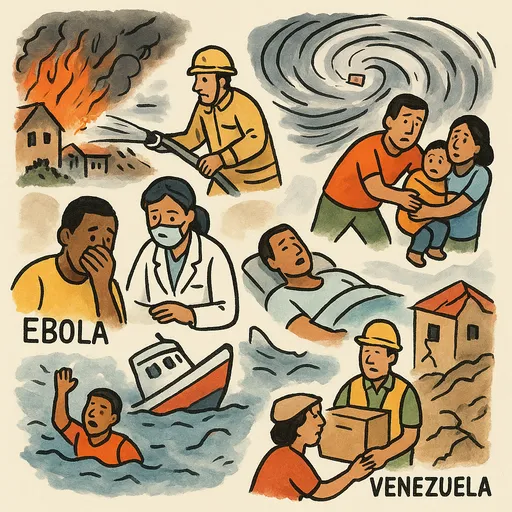
Over the period covered, responders confronted multiple large-scale natural disasters and fast-moving emergencies: deadly wildfires across southern Europe have killed and displaced residents and foreign tourists while firefighting teams struggle for containment. In East Asia, Typhoon Bavi forced mass evacuations — nearly two million people in China alone — and caused casualties and widespread infrastructure disruption across the region. Simultaneously, protracted health emergencies in Africa, including an Ebola outbreak in the DRC and cholera in Sudan, are deepening humanitarian needs and straining overstretched responders. Major industrial and transport accidents — from a deadly shoe-factory blaze in China to a speedboat capsize in Vietnam — added acute rescue and recovery operations, while Venezuela’s earthquakes prompted large international aid flows and political disputes over reconstruction leadership. Across these events, countries and international agencies mobilized evacuations, search-and-rescue, medical response and relief logistics, but access, funding and security constraints repeatedly hampered relief operations.
Reporting from multiple countries emphasizes the scale and human toll of fast-moving wildfires in Spain and neighboring regions, focusing on fatalities, missing people, and large evacuations. Coverage highlights firefighting efforts, resource mobilization, and questions about causes and prevention amid extreme heat and dry conditions.
Sources from across East Asia and beyond stress the unprecedented scale of evacuations and preparedness measures as Typhoon Bavi struck, with strong emphasis on sheltering, transport disruption and casualty reports in the Philippines, Taiwan and China. Coverage underscores cross-border coordination, public-health implications and the strain on regional emergency services.
Reporting highlights a faltering Ebola response in the Democratic Republic of the Congo, with international agencies and aid groups warning that the outbreak is under-resourced and hampered by access and funding gaps. Coverage focuses on rising case and death counts, contact tracing and strikes or pay disputes among health workers that threaten containment.
Sources emphasize a worsening public-health picture in Sudan as cholera spreads amid conflict-driven displacement and precarious returns to Khartoum. The perspective stresses the urgent need for water, sanitation, surveillance and unhindered humanitarian access to prevent further escalation.
Coverage from regional outlets frames Venezuela’s earthquakes as a large-scale humanitarian emergency with a mounting death toll, widespread destruction and urgent relief needs; reporting also highlights diplomatic tensions over who should lead reconstruction. Articles emphasize international solidarity, aid shipments and calls to release frozen assets to fund recovery.
Multiple reports from diverse sources concentrate on a single maritime disaster off Phu Quoc island in Vietnam, noting the high death toll among Indian tourists, ongoing search-and-rescue efforts and questions about safety regulations for tourist vessels. Coverage focuses on immediate response and investigation into causes.
Reports stress the social and service impacts of nationwide blackouts in Cuba and show international solidarity responses, including donated aid shipments. The perspective centers on restoration efforts and cooperation to mitigate hardships for affected populations.
Coverage draws attention to deadly workplace and extraction-site accidents — notably a large shoe-factory blaze in China and an artisanal mine collapse in Sudan — highlighting questions about safety standards and the urgency of rescue and investigations. Reporting stresses regulatory and labor-safety implications alongside emergency response.
U.S.-based coverage concentrates on dramatic helicopter evacuations after flash flooding cut off ground routes to a campground, emphasizing rapid rescue of children and group leaders and the logistical challenges of flood response. The perspective highlights search-and-rescue coordination and short-term sheltering needs.
Reports focus on fatal small-aircraft accidents in the Bahamas, detailing immediate rescue responses, casualty figures and ongoing investigations into causes. Coverage underscores aviation-safety concerns and implications for regional air travel.
Regional reporting covers deadly road crashes that triggered emergency responses and investigations, stressing roadside rescue, road closures and the human toll. The perspective highlights road-safety risks on major routes and the role of emergency services in post-crash response.
This group brings together reporting on storms and flooding that caused widespread infrastructure damage and power outages, emphasizing recovery work by utility crews and disaster services. Coverage stresses the secondary hazards (power loss, displaced populations) and the need for rapid repairs.
Reports from the region highlight severe degradation of health transport capacity, with a large share of ambulances out of service and serious implications for emergency medical response. The perspective calls for urgent restoration of logistics to avert increased civilian suffering.
These articles cover intensive, high-profile rescue operations — from a hostage rescue underway in Berlin to mass child rescues in Nigeria — emphasizing multi-agency coordination and security complexities. Reporting underscores the operational challenges of protecting lives in volatile settings.
Coverage on new heat-warning systems stresses rising extremes of heat and the use of formal emergency ratings to trigger public-protection measures, with authorities urging people to limit outdoor activity. The perspective highlights adaptation measures and early-warning policy changes.
Reporting on Chad highlights a deepening displacement crisis driven by regional conflicts, with UNHCR warnings about large-scale needs and calls for expanded humanitarian access. The perspective stresses protection needs for refugees and internally displaced people.
This item highlights a fatal shark attack near Sydney, focusing on emergency response, lifeguard action and public-safety advisories for beachgoers. The perspective underscores immediate rescue efforts and subsequent safety investigations.
Coverage of tremors in Hungary centers on immediate assessments by authorities, initial damage surveys and public warnings about aftershocks. The perspective emphasizes rapid damage appraisal and preparedness for further seismic activity.