
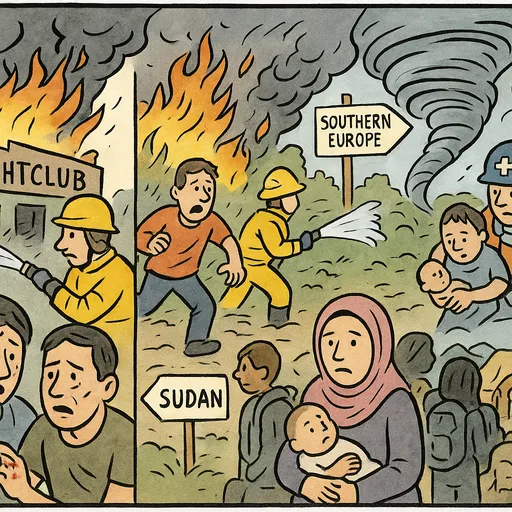
Recent international reporting shows an intense surge of simultaneous emergencies demanding large-scale rescue and relief operations: a deadly nightclub and industrial-fire disaster in Bangkok with dozens killed and many injured, lethal wildfires across southern Europe and near Paris, and a major typhoon prompting mass evacuations in eastern China and regional impacts. Conflict-driven displacement and fragile returns in Sudan and overflowing refugee camps in neighboring Chad are straining humanitarian capacity, while Venezuela continues to tally very high earthquake casualties even as diaspora and international donors mobilize aid amid political disputes over reconstruction leadership. Public-health emergencies, including a growing Ebola outbreak in the Democratic Republic of the Congo and cholera complicated by insecurity in northeast Nigeria, are being compounded by attacks on health and aid teams that complicate response. Across these crises responders are focusing on search-and-rescue, large evacuations, medical evacuations and international relief shipments while investigators and authorities probe causes, safety compliance and coordination gaps.
International outlets report the Bangkok bar and nearby industrial fires as immediate rescue and investigation stories, emphasizing casualties, chaotic evacuations, and possible safety or exit obstructions at nightlife venues. Coverage stresses emergency responders' efforts, hospital transfers of the injured, eyewitness accounts and pending inquiries into compliance with fire-safety standards.
Reports from European and international outlets frame the Andalusia and Fontainebleau blazes as part of an extreme-heat and drought-driven wave of wildfires, highlighting evacuations, rising death tolls and the strain on firefighting resources. Coverage also notes domestic political reactions and disputes over warning systems and preparedness as authorities work to contain fires and begin recovery and victim identification.
Coverage emphasizes pre-emptive evacuations, emergency mobilization and cross-border impacts as Typhoon Bavi (later downgraded) made landfall in eastern China while affecting the Philippines, Taiwan and Japan. Reports focus on the scale of relocations, transport disruptions, rescue readiness and continuing weather monitoring as authorities deploy response plans.
Reporting highlights the heavy human toll from June earthquakes and the mobilization of humanitarian support from diasporas, NGOs and foreign governments, alongside political friction about who should lead reconstruction. Coverage details rising casualty figures, incoming shipments, private donations and diplomatic involvement while noting challenges of coordinating large-scale relief.
Sources describe returns to Khartoum and surrounding areas as occurring amid severely degraded services, insecurity and damaged infrastructure, and they highlight cross-border humanitarian spillovers into Chad where floods and besieged camps have caused child deaths. The perspective stresses urgent needs for access, protection and reconstruction as returnees confront an unready capital.
Coverage links escalating public-health emergencies—most notably a severe Ebola outbreak in the DRC and a cholera outbreak in northeast Nigeria—to strains on health systems and the added danger posed by attacks or insecurity that hinder vaccination and treatment campaigns. Reports underline international concern, contact tracing, cases among aid workers and rising fatalities while calling for protected humanitarian access.
Articles focus on deadly factory fires and severe burn victims requiring cross-border medical evacuations, framing these as persistent occupational-safety problems that trigger investigations and international medical cooperation. Reporting highlights high fatality counts, enforcement questions and urgent transfers for specialized care.
Reports on capsizes, high-speed vehicle crashes at public events and related transport tragedies center on rescue operations, arrests and inquiries into safety practices and operator responsibility. Coverage follows emergency medical responses, search efforts for missing people and steps by authorities to hold parties accountable.
A range of other incidents—fatal animal attacks, storm preparations, urban floods, a surge in Gaza casualties and international solidarity shipments—are reported as part of the global relief landscape, emphasizing the diversity of hazards and the multiplicity of humanitarian responses. These pieces underline local emergency measures, international aid deliveries and the broader context of simultaneous crises.