

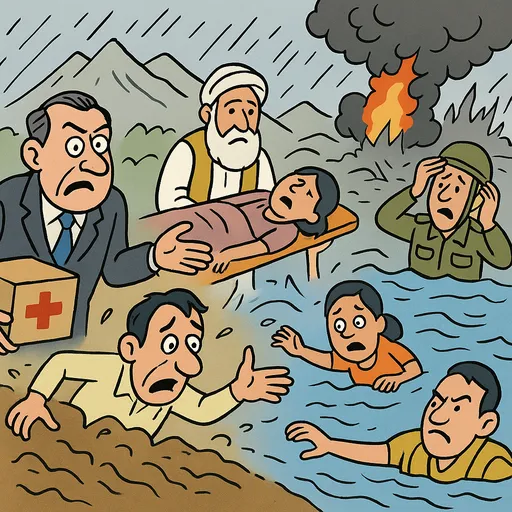
News coverage centers on a catastrophic series of disasters that are stressing rescue capacity and humanitarian systems worldwide. The Himalayan floods in Nepal dominate reporting with mounting death tolls, thousands missing, dramatic tunnel rescues and urgent appeals for water, shelter and international assistance. Separately, a major explosion at a Bolivian military facility produced heavy casualties and wide media scrutiny of safety and emergency response. Regional extreme-weather events — from Indonesian wildfires and earthquakes to record rains and landslide warnings in East Asia — along with attacks on aid convoys and infectious-disease outbreaks, further highlight the multiple fronts on which relief operations are being carried out and impeded.
Reporting from many countries emphasizes the human cost and search-and-rescue struggle following the Himalayan floods, highlighting tunnel rescues, mounting casualty figures, and urgent needs for water and shelter. Coverage focuses on both dramatic individual survivals and systemic challenges — difficult terrain, damaged infrastructure and the coordination of domestic and international aid.
Multiple outlets report on a large explosion at a Bolivian military installation, emphasizing casualty counts, missing personnel and emergency response while governments and investigators seek cause and accountability. Coverage frames the event as both a local humanitarian emergency and a potential safety/security failure at military depots.
Reports from the region highlight severe environmental events — wildfires in Indonesia, a major earthquake in Indonesia, record rainfall and bridge collapses in China and landslide/typhoon warnings in Japan — stressing cross-border health, air-quality and evacuation concerns. The perspective underscores scientific monitoring (satellites, mapping) and the need for preparedness and coordinated firefighting, evacuation and relief efforts.
Coverage draws attention to how insecurity and disease hamper relief: attacks on vaccination teams and aid convoys threaten lifesaving programs, while Ebola surges in the DRC increase pressure on health responders. The reporting frames these incidents as impediments to humanitarian access and calls for protection of aid workers and supplies.
Several reports document deadly transport accidents — shipwrecks, an overturned passenger boat, a small plane crash and a fatal bus crash — stressing urgent search-and-rescue operations and immediate medical response. The perspective focuses on rescue logistics, casualty figures and accountability for safety standards.
This group highlights international humanitarian responses and citizen-led assistance: field hospitals and medical teams, donations to relief funds, Red Cross transfers and community or religious-organized repatriations. Coverage emphasizes the role of external assistance — both governmental and non-governmental — in supplementing local capacity after disasters.
A range of other emergency reports covers airport closures and evacuations, power outages, hazardous-substance alerts and fatalities from illicit activity, illustrating how infrastructure disruptions and security incidents trigger rapid emergency responses. These stories stress public-safety procedures, contingency operations and the consequences for affected civilians.