
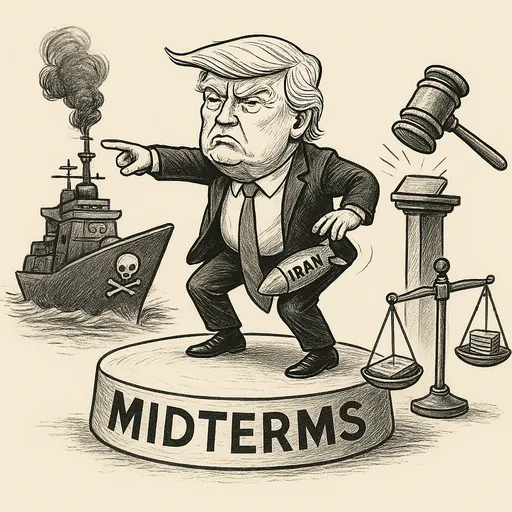
Coverage of Donald Trump’s actions and statements shows two dominant strains: aggressive foreign-policy posturing—particularly repeated threats and claimed strikes against Iran—and sustained domestic controversies including legal challenges to executive orders, pardons, and personnel scandals. International reporting highlights rhetoric about military readiness, control of strategic chokepoints like the Strait of Hormuz, and contingency plans for the Middle East, while many outlets note risks of escalation. At home, courts continue to block or suspend Trump-backed decrees on mail-in voting and birthright citizenship, and stories of alleged misconduct by officials fuel political scrutiny. Cultural and symbolic moves—coins, monuments, place renamings, and publicity stunts such as themed games—underscore how image, messaging, and patronage remain central to his influence ahead of the midterms.
Lithuanian reporting singled out interpersonal clashes involving Trump and U.S. commentators, treating such incidents as emblematic of domestic volatility. The focus is on public perception and the fractious tone of American political discourse.
Norwegian pieces combined investigative scrutiny of alleged misconduct by Trump appointees with coverage of his blunt public commentary, from a child murder case to threats against Iran. The reporting frames these items as evidence of both domestic ethical concerns and provocative foreign-policy rhetoric.
Emirati live updates emphasized immediate risk and uncertainty, foregrounding Trump’s threats of strikes on Iranian nuclear sites as a source of regional alarm. Coverage focuses on the developing situation and potential military escalation.
Kenyan coverage noted judicial pushback, reporting that a U.S. judge blocked Trump’s order limiting birthright citizenship as a significant legal rebuke. The piece frames the decision within constitutional debate over executive power.
Nigerian outlets highlighted connections between U.S. appointments and Nigerian figures, Trump’s political warnings about impeachment tied to elections, and the large-scale visa revocations under his administration. The perspective blends interest in bilateral ties with concern about policy consequences for Nigerians.
Lebanese reporting analyzed Trump’s asserted control of strategic waterways and detailed proposed post-conflict Middle East strategies, treating his statements as part of a grand regional vision. Coverage emphasizes potential geopolitical realignments and regional reactions.
The Maldives report focused on a circulating photo of Trump, treating the image’s authenticity and dissemination as a media story rather than a political development. The piece centers on information flows and public perception.
Coverage in Palestine emphasized the controversy around Trump’s mass pardons, noting beneficiaries’ celebrity ties and the broader accountability debate. The tone questions clemency choices and their political implications.
Tajik reporting highlighted symbolic recognition, reporting that Trump became the first living U.S. president in a century to appear on a coin. The piece frames this as historically notable and symbolic.
Paraguay focused on a light political anecdote—Trump’s comment that he was glad Meghan and Harry left the U.S.—framing it as political celebrity commentary rather than major policy news. The tone is cultural and mildly critical.
Malian coverage relayed Trump’s boast of U.S. control of the Strait of Hormuz after strikes on Iranian ships, reflecting skepticism and concern over unverified military claims. The piece stresses regional implications and the difficulty of independent verification.
Canadian (Quebec) reporting emphasized judicial oversight, describing a federal judge’s extension of the suspension on Trump’s mail-in voting restrictions. The focus is on impacts for election administration and voter access.
American Samoan commentary critiqued Trump’s executive order on critical minerals, foregrounding local environmental and economic concerns. The op-ed argues for consideration of territorial interests often sidelined in national policy.
South Korean coverage highlighted Trump’s threat to halt trade with deficit countries if the Fed did not cut rates, framing it as disruptive and protectionist rhetoric with potential global economic consequences. The reporting underscores market and diplomatic risks.
Philippine reporting relayed Trump downplaying the significance of a potential Iran war, framing it as political rhetoric timed ahead of elections. The piece stresses the administration’s attempt to minimize perceived domestic impact.
Azerbaijan reported Trump’s dismissal of inflation fears as a ‘false reality,’ portraying his comments as attempts to shape economic narratives. The coverage notes the implications for public confidence and political messaging.
Haiti reported Trump’s decree renaming Lake Ontario to ‘Lake America’ as a symbolic, controversial gesture that raises questions about national image and bilateral sensitivities with Canada. The piece treats the act as largely symbolic rather than practical.
Danish pieces mixed satire and critique, recounting a reported rude gesture toward Argentina’s president and Trump’s labeling of an event as a ‘terrible tragedy,’ using these anecdotes to comment on presidential comportment. The perspective views such episodes as reflective of shifting diplomatic norms.
Singaporean reporting emphasized the scale of Trump’s campaign financing, noting planned super PAC spending of $400–500 million and the role of outside money in U.S. midterms. The focus is on electoral influence and financial muscle.
Pakistan reported Trump’s criticism of Spain over migration and renewed attacks on NATO, framing it as part of a combative diplomatic style that complicates multilateral relationships. The article foregrounds tensions with allies.
Belgian coverage combined interest in Trump’s ambitious memorial projects—like a giant Arc de Triomphe—with reports on legal setbacks such as court extensions halting mail-in voting rules. The dual angle highlights symbolism and institutional checks.
Indian reporting focused on a Missouri court blocking a Trump-backed House map and ordering a public vote, framing it as another example of judicial intervention in politically charged redistricting. The tone underscores legal constraints on partisan maps.
Uzbek reporting treated the White House release of Trump-themed video games as a political stunt that trivializes immigration policy, emphasizing the blending of political messaging with entertainment. The piece questions the taste and intent behind the games.
Greenlandic coverage noted Trump’s engagement with the travel industry about declining U.S. tourism, framing it as an economic concern with practical implications for recovery strategies. The reporting emphasizes industry-level responses.
Dutch reporting covered a U.S. district judge blocking tighter mail-in voting rules, stressing risks of disenfranchisement and ongoing legal appeals. The piece places the ruling within broader democratic safeguards.
Afghan coverage relayed Trump’s rejection of reports about falling ammunition stockpiles, framing his comments as reassurances amid questions of readiness. The article treats official denials skeptically and notes broader defense debates.
Hong Kong reporting echoed concerns that Trump might cut trade ties if the Fed doesn’t lower rates, emphasizing economic fallout and signaling unease in financial markets. The piece connects U.S. monetary policy rhetoric to international trade relations.
Bosnian reports highlighted Trump’s threats to the Fed and drastic trade measures, as well as an extreme comment about Spain being ‘destroyed,’ presenting his rhetoric as destabilizing. The perspective stresses alarm at incendiary language.
Brazilian commentary examined Trump’s penchant for renaming and symbolic acts, analyzing motives tied to identity politics and electoral strategy rather than practical governance. The piece situates these moves in a broader political narrative.
Guatemalan reporting conveyed Trump’s contradictory stance toward Mexico—deriding cultural exports while praising its president—framing it as pragmatic electoral rhetoric with diplomatic undertones. The piece notes the mixed signals in bilateral relations.
Romanian coverage speculated on dramatic domestic scenarios, including a possible Trump resignation after the elections, treating such outcomes as destabilizing contingencies for U.S. politics. The analysis focuses on succession dynamics and power struggles.
Bulgarian reporting covered Tetris accusing Trump of theft, framing it as an entertainment-industry legal spat that intersects with his broader public profile. The piece treats the case as emblematic of media and IP clashes.
Cypriot coverage emphasized Trump downplaying the US–Iran clash and framing the conflict as manageable ahead of midterms, warning analysts that such rhetoric risks escalation. The perspective is cautious about belittling wartime consequences.
Moroccan reporting relayed that U.S. forces stand ready to strike Iran again, emphasizing the immediacy of military readiness and potential regional fallout. The piece warns of escalation and wider security effects.
Mozambique reported the U.S. Treasury’s issuance of a $1 coin featuring Trump, focusing on the symbolic nature of currency portraiture. The article treats the coin as a notable domestic commemoration.
Kazakh reporting similarly covered the release of one-dollar coins bearing Trump’s portrait, framing the minting as part of standard commemorative practices with political resonance. The piece is descriptive and symbolic.
Malaysian reporting highlighted Trump’s push to strip endangered species protections for wolves, framing it as a rollback of conservation measures and a contentious domestic policy shift. The perspective underscores ecological and regulatory consequences.
New Zealand reported on Trump sending envoys to Moscow and Kyiv with a Ukraine peace plan, framing it as renewed U.S. engagement in mediation efforts that will test diplomatic reception. The piece focuses on prospects for ceasefire and negotiation.
Peruvian analysis argued Trump benefits from having compliant Venezuelan intermediaries, treating such relationships as strategic assets that could shape bilateral influence. The perspective is geopolitical and cautionary.
Dominican reporting relayed allegations that Trump’s Labor Secretary drank at work and embezzled funds, framing the story as another instance of misconduct tied to his administration. The article notes possible investigations.
Italian coverage contrasted Bush’s quiet artistic responses with the loudness of Trump-era politics, using art as a form of subtle critique rather than direct political confrontation. The piece reflects on alternative modes of public engagement.