

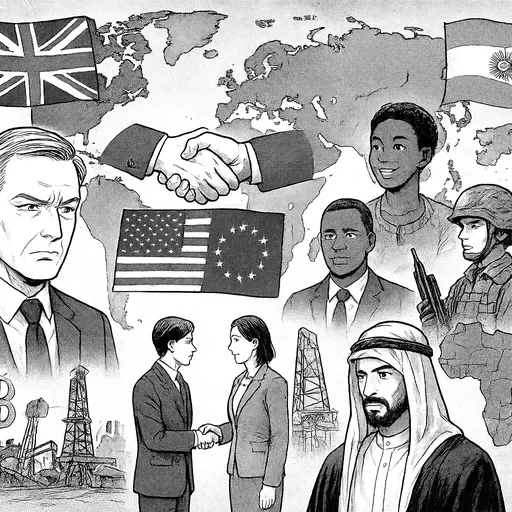
This set of articles shows a worldwide uptick in bilateral initiatives spanning trade pacts, security partnerships, development financing and diplomatic positioning. Major commercial moves—such as the UK–Australia trade deal and efforts to ease U.S.–EU trade frictions—sit alongside energy and investment accords, notably new U.S.–Venezuela oil cooperation and African trade arrangements under AGOA. Security and capacity-building partnerships are visible in the Pacific and Africa, while smaller states secure targeted assistance and credit lines to boost infrastructure and connectivity. Concurrently, geopolitical frictions persist: Argentine claims over the Falklands, embassy relocation debates over Jerusalem among African states, and episodic diplomatic spats underscore how bilateral deals can both stabilise and strain regional relations.
Argentina's leadership is reasserting sovereignty claims over the Falkland Islands, framing the islands as historically and legally Argentine and prompting diplomatic responses from other states. The stance is presented as a priority of national diplomacy, even as neighbouring and external partners stress adherence to treaties and existing bilateral arrangements.
The Solomon Islands are deepening ties with a mix of partners for security, development and capacity building, notably with Australia, the Saudi Fund and China. Reports emphasize Australian-backed programs for policing and construction, Saudi-funded development financing, and Chinese community-level assistance, reflecting a diversified external engagement strategy.
Australia and the United Kingdom have concluded a bilateral free trade agreement intended to cut tariffs and broaden post‑Brexit economic ties. Officials present the deal as a step to deepen investment and regulatory cooperation while observers highlight its symbolic value in reshaping trade ties.
U.S. officials are taking steps to reduce commercial tensions with the European Union ahead of high‑level diplomatic engagements, signalling a preference for smoother transatlantic trade relations. The measures are framed as pragmatic economic diplomacy amid broader geopolitical calculations.
Bilateral tensions between Brazil and Argentina have escalated to the point of a diplomatic recall request, indicating a serious breakdown in relations. The move points to acute political disagreements with potential regional diplomatic consequences.
Guinea is actively managing relationships with both Western and Chinese partners, appointing an ambassador to the United States while receiving mobilised resources from a Chinese consortium for a major mining project. The coverage frames Guinea as pursuing diversified diplomatic and economic support to advance national development projects.
Russia and Ukraine agreed to suspend bombardments of each other’s capitals for short, specified periods tied to U.S. envoys' visits, presenting a tactical pause to reduce escalation risks during high‑level diplomacy. The measures are portrayed as temporary and pragmatic steps to facilitate talks rather than a durable ceasefire.
Laos has pursued a concentrated diplomatic push to deepen cooperation with Kazakhstan and Belarus across trade, energy, education and legal cooperation, with high‑level visits and memoranda signed. Reporting stresses a sustained effort to convert political commitments into concrete projects and institutional links.
Pacific island states and external partners are strengthening security and development ties through patrol cooperation, defence partnerships and financial packages from major partners such as Japan, the United States, France and Australia. Coverage emphasises capacity‑building, interoperability and substantial funding commitments aimed at regional stability.
The United States and Venezuela have advanced energy‑sector cooperation through new oil production deals and parliamentary approvals that could unlock investment and boost output. Analysts caution over timelines and political conditions, noting uncertainty about when economic benefits will reach broader populations.
A small but notable group of African states are revisiting or announcing plans to shift diplomatic recognition toward Jerusalem, reflecting a reorientation in some foreign policy stances. The developments reveal divisions across the continent and potential diplomatic repercussions with traditional partners.
Kyrgyzstan is advancing both commercial cooperation and institutional dialogue, including new business ties with Georgia and a Kyrgyz‑German focus on tourism, IT and green technologies while managing ambassadorial transitions to Korea. The reporting underscores a multi‑track approach to integration with regional and European partners.
Togo is actively renewing and initiating bilateral consultations with Cambodia and Vietnam, seeking to diversify its international partnerships and attract new trade and investment opportunities. Economic data also show Asia’s dominant role in Togo’s trade flows, reinforcing the strategic pivot.
Niger has publicly thanked Russia and allied partners for rapid support after a security incident while simultaneously denouncing alleged French-led networks, signalling a pronounced geopolitical tilt and rising tensions with France. The coverage presents Niamey as seeking alternative security partnerships.
Portugal announced a dedicated €100 million credit line for Portuguese firms investing in Cabo Verde during a presidential visit, framing the measure as a concrete step to strengthen bilateral economic ties. The visit underscores official political support for deeper commercial engagement.
Regional players are formalising cooperation on infrastructure and regulatory coordination, from a Balkan energy memorandum to cross‑border competition enforcement in Southern Africa. These agreements are presented as practical steps to integrate markets and enhance delivery of public works.
China’s engagement in Egypt—symbolised by Xi Jinping’s visit and longstanding cinema/media cooperation—reflects Beijing’s dual emphasis on cultural diplomacy and strategic partnership in the Middle East and Africa. Egyptian leaders frame the relationship as part of a balancing act to attract major‑power support while maintaining regional agency.
A broad set of countries report routine but significant bilateral activity—state visits, trade missions, ambassadorial appointments, labour and finance talks, transport links and development pledges—illustrating that bilateral diplomacy remains the primary vehicle for concrete cooperation across regions. These items together show steady, pragmatic engagement to advance trade, connectivity, capacity building and political relations at multiple levels.