
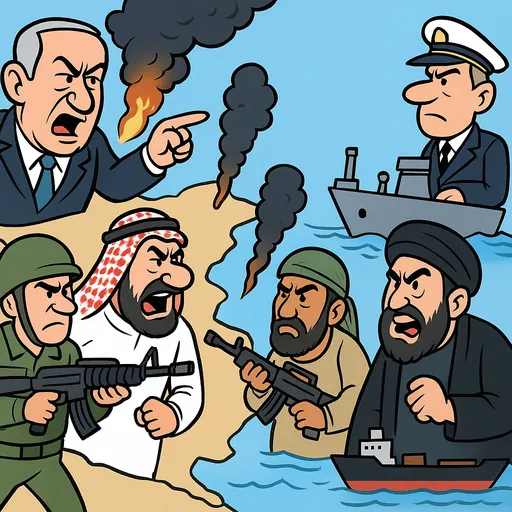
A broad uptick in cross‑border attacks and military warnings has driven a day‑to‑day escalation across the Levant, the Gulf and Yemen. Israeli operations and hardline statements have produced repeated strikes in southern Lebanon and the West Bank, causing civilian casualties and sharp diplomatic protests. Simultaneously, the Yemen conflict has spilled into the Gulf corridor as Houthi strikes on Saudi targets and allied militia statements deepen regional alignments and humanitarian suffering. Frequent US‑Iran naval exchanges, attacks on tankers and threats to energy infrastructure have disrupted shipping and raised fears of a wider confrontation, while analysts warn the low‑intensity US–Iran confrontation could persist and that Syria’s reported weapons concerns would further complicate regional stability.
Reports and statements emphasize Israeli military operations, detention or legal actions and warnings of forceful responses to perceived threats. The perspective frames strikes and raids as security measures intended to neutralize hostile actors along the northern border and in the occupied territories.
Coverage from Lebanese and regional outlets highlights civilian deaths, damage and political denunciations of Israeli strikes in southern Lebanon. The viewpoint stresses humanitarian consequences, denouncements by Lebanese leaders and appeals to international actors to halt the escalation.
Houthi statements and allied militia declarations portray cross‑border strikes on Saudi targets as retaliation and a deliberate pressure tactic, while accusing Saudi‑led forces of serious abuses at home. This stance frames Yemen’s conflict as a regional flashpoint with the Houthis and sympathetic militias asserting both military reach and political grievance.
Reports tied to the Yemeni government and on‑the‑ground coverage emphasise offensives by pro‑government forces, territorial advances and the severe humanitarian consequences of renewed fighting. The perspective underlines civilian displacement, rising casualty counts and the fragility of ceasefires.
Maritime and Gulf reporting focuses on direct exchanges between US and Iranian forces, attacks on vessels and disruptions in the Strait of Hormuz that threaten global energy flows. The viewpoint links naval confrontations, covert clearing operations and threats to energy infrastructure as central risks that could broaden the conflict.
Analyses and intelligence‑sourced pieces emphasize Tehran’s readiness to raise the stakes—directly or through proxies—and U.S. concern that Iran may prolong or intensify confrontations. The perspective stresses diplomatic and military signaling as part of a calculated effort to alter regional dynamics without triggering all‑out war.
Coverage on Syria and Iraq combines battlefield updates with alarming reports claiming clandestine weapons developments, including allegations about Assad’s regime and inspections into suspected facilities. The viewpoint highlights how potential WMD issues and continued fighting in Iraq and Syria add another layer of regional instability.
Reports from Palestinian and international sources focus on settler violence, prosecutions of religious figures, West Bank attacks and warnings that rising violence undermines the two‑state solution. The perspective frames these incidents as both immediate security incidents and threats to any future diplomatic settlement.
Statements from Turkish leadership use combative rhetoric stressing national defense and regional posture, reflecting Ankara’s heightened security messaging amid wider instability. The perspective signals a readiness to contest perceived encirclement and reinforce Turkey’s regional stance.