

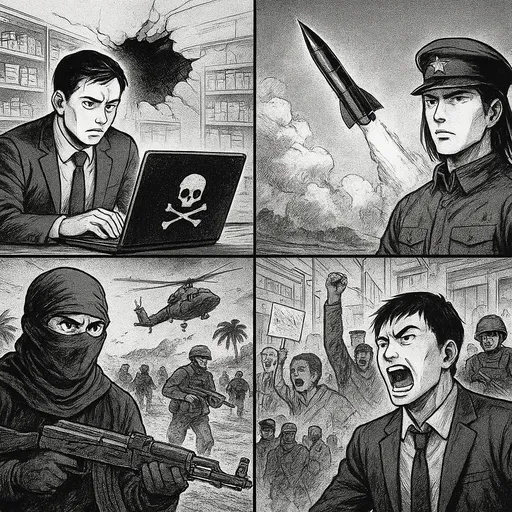
This collection of reports shows a multi‑dimensional rise in security threats: large-scale cyber‑physical intrusions that disrupted French supermarkets and industrial production, persistent ballistic missile tests by North Korea, and high‑casualty attacks on Riyadh’s airport that prompted regional alarm and international attribution disputes. European governments and NATO members are sounding repeated warnings about Russian hybrid campaigns, espionage and assassination plots while also grappling with domestic surveillance scandals and political instability. Across Africa and parts of Asia, renewed rebellions, cross‑border incursions and deadly strikes have amplified regional fragility and humanitarian risks. Maritime, satellite and airbase incidents—including Starlink/ground station probes and Black Sea drone strikes—add a transnational security layer, even as local mass shootings, targeted killings and protest‑related unrest strain policing and public safety systems.
Multiple sources highlight coordinated cyber intrusions that manipulated industrial and retail control systems, most notably French supermarket refrigeration and at least one major automaker. Reporting stresses broad economic and public‑safety impacts, gaps in cyber insurance, and the vulnerability of connected supply chains and legacy firmware.
Regional and allied outlets frame Pyongyang’s repeated ballistic launches as an escalating security challenge that provokes trilateral consultations among South Korea, the United States and Japan. Coverage mixes technical details of ranges and capabilities with diplomatic and military reassurance that, for now, launches do not pose immediate homeland threats.
Reporting from the Gulf and Western capitals places recent devastating strikes on Riyadh’s airport at the center of a wider escalation: Houthi claims and threats, allied attributions implicating Iranian proxies or the IRGC, and coordinated international diplomatic responses. Stories emphasize human toll, suspended flight operations, scrutiny of air‑defence failings, and calls among allies for firm reprisals or accountability.
European and regional outlets warn of an expanded Russian hybrid toolkit—sabotage, disinformation, covert operations and suspected assassination plots—prompting calls for stronger NATO preparedness and internal safeguards. Poland’s spate of security incidents, a Pegasus surveillance scandal and public statements from leaders are portrayed as part of a wider Western reckoning with foreign interference and internal vulnerabilities.
Reports from and about Africa document leadership shifts in insurgent movements, cross‑border incursions, deadly attacks on civilians and resource‑area violence that deepen regional fragility. Coverage connects political realignments—such as Joseph Kabila’s new grouping and renewed fighting in eastern DRC—with humanitarian consequences, artisanal mining massacres and the challenge of restoring stability.
National outlets report a string of deadly or disruptive incidents—from school shootings and attacks on public‑health teams to workplace murders and livestreamed killings—that underscore rising domestic security concerns. The perspective focuses on immediate law‑enforcement responses, survivor and community impacts, and debates over prevention and protection in public and workplace settings.
Analyses and investigations cover the political use of spyware, the role of botnets and platform policy responses, plus high‑profile law‑enforcement raids that intersect with partisan controversy. Sources emphasize the risks to civil liberties, the influence of covert tools on domestic politics, and the evolving efforts by governments and platforms to constrain malign online activity.
Reports describe a range of transnational incidents—Starlink ground‑station fires and detentions, U.S. interdictions at sea, drone and unexplained attacks in the Black Sea, and security scares near airbases—that illustrate how maritime and space‑adjacent domains are becoming contested. Coverage stresses the cross‑border investigative and alliance coordination these events require.
Allied reporting highlights reinforced deterrence postures, multinational exercises and rapid advancement in missile, drone and counter‑air systems as governments prepare for hybrid and conventional contingencies. The view presented links political will, technological investments and doctrine updates to a broader goal of denying escalation and protecting alliance territory.
A set of pieces connects street unrest, xenophobic backlash and underground financial networks to strains on governance and rule of law—from organized drug trafficking and hidden airstrips to anti‑foreigner violence amplified online. Sources call for stronger enforcement, transparency and social‑policy responses to prevent escalation and criminal exploitation of unrest.