

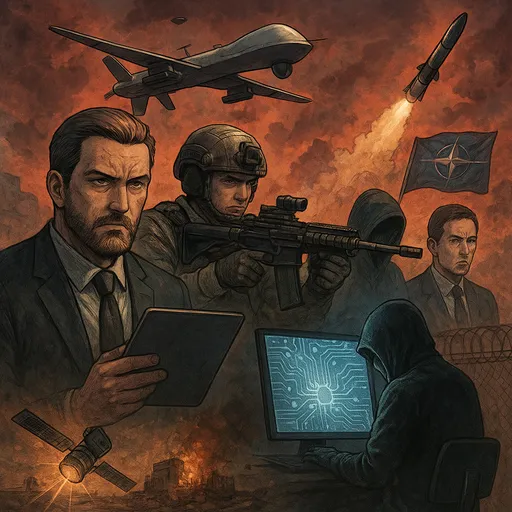
Across regions analysts and authorities report an expansion and cross-border coordination of diverse threats, from drone and maritime strikes in the Black Sea and Gulf to rising cyber operations targeting critical infrastructure and services. Intelligence and defence officials warn of growing espionage, internal security breaches and weapon tests — notably from North Korea and proxy actors in the Middle East — that are prompting exercises, deterrence postures and procurement drives. Satellite and communications disruptions, including repeated Starlink outages and targeted sabotage, are shown to have immediate operational and humanitarian consequences for Ukraine and other actors. NATO, regional militaries and security services are reacting with heightened readiness, counter-drone investments and international probes, while some states pursue hardline domestic security measures and prison models as part of broader efforts to cope with mounting threats.
European and Western sources emphasise an elevated threat from Russian-directed or Russia-adjacent operations, prompting intelligence alerts and firm alliance rhetoric. Officials stress preparedness and deterrence, and report incidents that feed wider concern about Moscow’s ambitions and influence in Europe and beyond.
Regional press documents multiple drone and projectile strikes on merchant vessels and tankers in the Black Sea, viewed as spillover from the Ukraine conflict with serious implications for shipping safety and regional stability. Governments are investigating origins and authorship while coordinating search, rescue and forensic responses.
Reports from Middle Eastern sources emphasise evolving Iranian and Houthi maritime tactics that have damaged ships and exposed gaps in regional defences, prompting urgent reviews of air and sea security. U.S. and regional advisories and changes in targeting patterns are producing heightened caution around the Strait of Hormuz and major airports.
East Asian coverage highlights Pyongyang’s continued weapons displays and submarine-launched missile tests, and regional responses that include defence buildups and diplomacy at multilateral fora. Tokyo, Seoul and allied commanders frame these provocations as drivers for readiness and changes to force posture.
Journalists and industry sources report a wave of disruptive cyber incidents—targeting retail refrigeration, automakers, government domains and financial data centres—that underline systemic vulnerabilities in supply chains and services. Policymakers and executives call for stronger cyber resilience, insurance and international cooperation to stem economic and public-health fallout.
Reports from several countries highlight alleged state-linked spying, workplace bugging and misuse of surveillance tools, prompting probes and reputational fallout. Media and governments frame these incidents as symptomatic of rising intelligence contestation and risks to personnel privacy and press freedom.
Multiple reports recount hijack threats, diversion of commercial flights and probes into air-traffic-control systems, raising questions about aviation security procedures and system vulnerabilities. Aviation authorities are investigating both procedural lapses and false alarms to restore passenger confidence.
Ukrainian officials and international outlets describe repeated Starlink outages, sabotage of ground antennas and political disputes over service continuity, arguing that satellite connectivity is now a battlefield asset essential for defence and civilian protection. Appeals from Kyiv and public disputes underscore how commercial satellite services affect wartime resilience.
Western defence reporting stresses accelerated funding and procurement to counter inexpensive drone threats, while regional actors document adversaries’ growing drone campaigns. The consensus is that cheap drones require large-scale investment in detection and mitigation to close emerging defensive gaps.
Coverage from Latin America and elsewhere shows governments adopting tougher detention regimes and large prisons as part of anti-crime strategies, while arrests of high-profile cartel figures and dramatic jailbreaks reflect continuing organised-crime challenges. These measures generate debate about effectiveness and human-rights trade-offs.
Several reports focus on perceived lapses in allied warning systems and intelligence-sharing, with leaders and ex-officials publicly disputing who knew what about critical warnings and attacks. These disputes are prompting calls for improved coordination and accountability among partners.
Regional outlets document insurgent attacks, suspected cross-border logistics, militia clashes and foiled plots, emphasising both local trauma and the transnational character of modern extremist and armed groups. Governments and international monitors highlight the need for cross-border cooperation to contain escalation.
Military and defence reports record unmanned aerial intrusions and discoveries of unidentified debris in national airspace, prompting investigations and calls for improved detection and coordination. Such episodes raise public concern and stress the limits of current monitoring systems.
Allied and partner states are visibly testing new capabilities, conducting naval deployments and holding alliance exercises to reassure partners and deter adversaries. These moves are framed as both defensive preparedness and signals in competitive theatres from the Indian Ocean to the South Atlantic.
Commentators and experts warn that live-streamed extreme violence has broad psychological and social effects, especially on children, and call for guidance from authorities and educators. The concern connects digital-platform dynamics with the human costs of modern public violence.
National studies and police note rising fraud and scams undermining public confidence, stressing the need for stronger prevention, policing and digital literacy. These everyday cyber harms are presented as part of a broader uptick in insecurity tied to digital adoption.