

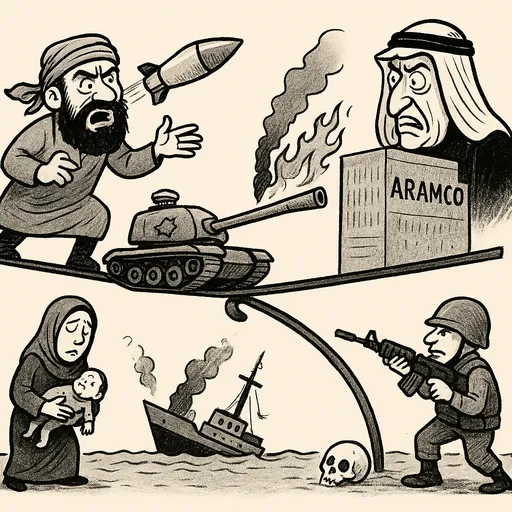
Violence across the Middle East intensified over the reporting period, driven by renewed Houthi strikes on Saudi targets—including an attack on Aramco’s headquarters and assaults near Riyadh airport—and reciprocal Saudi-led strikes inside Yemen. Simultaneously, maritime security deteriorated in the Strait of Hormuz and adjacent waterways, with multiple ships hit or sunk and U.S. forces striking vessels linked to Iran, raising fears for global shipping and energy markets. Israel has reinforced forces and issued threats toward Lebanon while settler violence and cross-border incidents continue, compounding regional tensions. Humanitarian reporting highlights a catastrophic situation in Gaza with massive civilian casualties and international condemnation, even as analysts warn that new missile capabilities, foreign components and wider proxy dynamics risk drawing more states into the conflict.
Reports and statements from or about the Houthi movement emphasize offensive operations and explicit warnings of further strikes against Saudi targets, portraying the group as escalating in response to Saudi actions. These items present Houthi claims of missile and attack successes and frequent declarations of retaliation, framing the conflict as persistent and intensifying.
Coverage centered on Gulf and coalition reactions stresses defensive measures, missile interceptions and retaliatory strikes against Houthi positions while warning about risks to energy infrastructure and domestic security. Commentators and regional outlets frame Riyadh’s options as constrained and portray Saudi action as necessary to protect critical facilities and airspace.
Western and U.S.-oriented reporting emphasizes threats to commercial shipping and naval responses in the Strait of Hormuz, documenting ships sunk or hit and U.S. strikes on vessels linked to Iran. These pieces frame the maritime incidents as a strategic pressure point that has prompted military action and diplomatic concern, with potential global economic repercussions.
Humanitarian reporting and international voices foreground the civilian toll of fighting, particularly in Gaza, with large casualty figures, personal testimonies and calls for accountability and access for aid. UN officials and rights advocates condemn attacks on civilian infrastructure and urge de-escalation and adherence to international humanitarian law.
Israeli-focused coverage highlights military reinforcement, political timing ahead of elections, and aggressive rhetoric toward Lebanon, alongside reporting of settler violence in the occupied West Bank. The perspective frames these developments as security responses to multiple threats on Israel’s borders and internal tensions that further fuel regional volatility.
Analytical pieces warn that new weapons flows and component supplies (including allegations of Chinese parts) are strengthening missile capabilities among non-state actors and complicating deterrence calculations. Coverage in this group also examines potential extreme options, the economic fallout of a widening war, and the spread of conflict into regions like the Horn of Africa.