

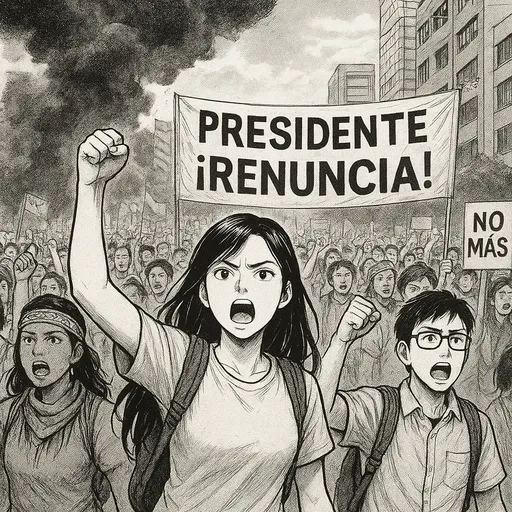
Thousands of Colombians, including unions, Indigenous groups, students and feminists, have mobilized in early mass demonstrations against President Abelardo de la Espriella's new government. Opposition leaders warn the unrest could escalate into a nationwide general strike in November as organizers coordinate pressure tactics. Reports emphasize public grievances over recent policies and economic conditions and note heavy security deployments to manage demonstrations. Visuals such as red smoke and large street turnouts underscore the depth of public discontent. One article in the set is unrelated, reporting an archaeological shipwreck discovery off Turkey's coast.
Peruvian coverage spotlights the organized political opposition and its warning of a nationwide general strike planned for November. It frames the protests as a coordinated strategy to pressure the government ahead of key policy decisions.
Nicaraguan reporting emphasizes a broad coalition of unions, Indigenous communities, students and feminists mobilizing against the administration and presents the demonstrations as a test of the new government's direction. It highlights references to former president Gustavo Petro as an ideological touchstone for opposition forces.
El Salvador's coverage focuses on the scale of the national strike and the deployment of security forces to maintain order during protests. The piece frames demonstrations mainly through grievances over policy and economic conditions affecting citizens.
Swiss reporting stresses street-level imagery—red flares, large crowds—and interprets the demonstrations as evidence of mounting political tension and public scrutiny of the administration. It also notes police measures taken as protests unfolded in major cities.
The Kazakhstani article is not related to Colombian politics; it reports an ancient shipwreck discovered off the coast of Turkey and focuses on maritime archaeology and historical significance. It appears in the set as an unrelated scientific/heritage story.