

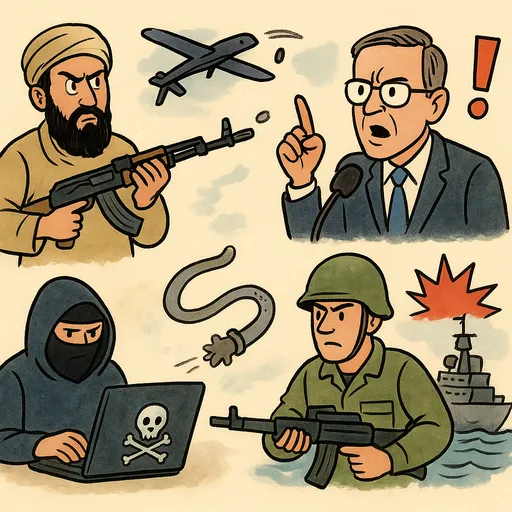
Reports from multiple regions show a simultaneous rise in kinetic, cyber and hybrid threats that are straining defence, law-enforcement and critical‑infrastructure resilience. In the Sahel and Sudan, deadly militant attacks and drone strikes are producing high civilian casualties and prompting military responses and humanitarian concerns. Democracies are confronting targeted political violence and public‑space attacks—most visibly in Australia and the United States—while nations and companies warn of growing cyber sabotage risks to industry, undersea cables and satellite communications. Regional tensions from the Korean peninsula to the Strait of Hormuz and the Levant are driving military drills, hardened rhetoric and event postponements, highlighting gaps in warning systems and alliance deterrence. Governments are reacting with heightened security measures, offensive directives and calls for deeper defence cooperation, underscoring how dispersed threats are scaling into systemic challenges.
Regional reporters emphasise brutal militant attacks and state abuses across Mali and nearby regions, documenting high civilian death tolls and executions. Coverage frames the violence as part of persistent Sahel instability that drives humanitarian alarm and heightens pressure on local and international responses.
Multiple outlets highlight waves of drone strikes and urban attacks in Sudan that have killed dozens and disrupted aid and security operations. The perspective stresses escalatory dynamics between armed factions and the risks to civilians and regional stability.
Australian reports focus on an apparent deliberate attack on an MP and related incidents, sparking debate about protection for public figures and immediate medical and legal responses. Coverage centres on investigation updates, political reactions and calls to review security for representatives.
Local and regional reporting conveys a government pivot to large‑scale military action against the ELN and FARC dissidents, framing the move as a no‑negotiation crackdown tied to hostage issues. The accounts portray a security-first policy response aimed at reasserting state control in contested border departments.
Coverage highlights growing cyberattacks on manufacturers, hacked supermarket refrigeration, attempted arson of Starlink gear and worries about undersea‑cable sabotage, linking technological vulnerabilities to national security. Journalists and analysts call for better defenses, insurance scrutiny and international collaboration to harden critical networks.
Reports from the region and global outlets underline Tehran’s bellicose rhetoric, warnings about targeting undersea cables and strikes near Hormuz, alongside Houthi attacks that have forced cancellation or postponement of major events. The perspective links maritime and communications vulnerabilities to broader diplomatic and military posturing in the Middle East.
European commentary stresses weak deterrence, Russian hybrid options short of all‑out war, thwarted intelligence operations and close satellite manoeuvres that raise space‑security concerns. The perspective urges deeper defence integration, new cross‑border mechanisms and readiness measures to counter rapid, non‑conventional pressure.
U.S. local reporting documents shootings at or near mosques, a deadly school shooting and other public‑space attacks, stressing community trauma and law‑enforcement investigations. The accounts underline persistent domestic security challenges and calls for preventative measures.
Regional outlets cover large U.S.–Japan exercises, Australian undersea warfare enhancements, and renewed North Korean threats, painting a picture of intensifying military preparedness and deterrence posture across East Asia. Diplomatic friction—evidenced by Manila summoning China’s envoy—adds to the sense of a region on edge.
Caribbean reporting identifies organised gangs responsible for major attacks on foreign troops, portraying the violence as a serious test for international interventions and regional security cooperation. The pieces stress operational risks for deployed units and the deteriorating security environment in Haiti.
Coverage from Africa and neighbouring countries highlights beheadings and allegations of forced disappearances of political figures and defectors, framing these as threats to dissidents abroad and tests of regional asylum protections. The reporting raises human‑rights concerns and potential diplomatic fallout.
Reports record expanded detentions, high‑profile trials, curfews and a spate of bombings linked to criminal factions, signalling domestic instability and law‑enforcement mobilization in parts of Europe. The perspective links organised crime and extremist gatherings to public‑safety measures and policing responses.
Local press highlights incidents from school stabbings and bomb threats to an in‑flight bomb scare that forced a diversion, underscoring ongoing vulnerabilities in everyday public settings and transport. Coverage emphasizes precautionary responses and ongoing investigations.
Reporting documents Wagner‑linked gold shipments and discussion of possible foreign military operations (e.g., Libya), illustrating how private military actors and external interventions intersect with resource flows and instability. The angle emphasizes the security and governance implications of mercenary networks.
Scientific reporting on an intensifying El Niño is framed as a risk multiplier that can exacerbate humanitarian and security crises through extreme weather and food‑system shocks. The piece calls attention to the strategic importance of climate monitoring for preparedness.