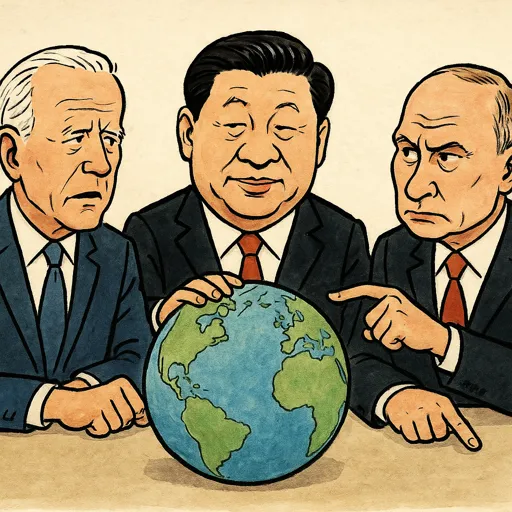
Leaders of the United States, China and Russia are jockeying to reshape post‑Cold War institutions and regional balances, with summit diplomacy underscoring a push toward a multipolar order. Beijing and Moscow are coordinating rhetoric on protectionism and sanctions while the United States faces questions about leverage and strategy. Moscow’s military signaling and Beijing’s technological and nuclear advances are recalibrating security calculations across Europe, Asia and the Indo‑Pacific. Hybrid operations, covert influence campaigns and the war in Ukraine add volatility, forcing allies to adapt force posture, export controls and diplomatic alignments.
Coverage centers on high‑level meetings in Shenzhen and APEC where Xi and Putin promoted a multipolar world and confronted Western policies, while the trilateral choreography exposed perceived U.S. weakness and uncertain outcomes. Commentators warn that rhetoric on protectionism, chips and governance reflects a broader effort by Beijing and Moscow to rewrite rules of international economic and security cooperation. These pieces treat summitry as both signal and bargaining space shaping alliance choices and strategic narratives.
Reports highlight renewed emphasis on strategic signaling: Russian deployments and Chinese nuclear modernization are unsettling rivals and complicating arms‑control prospects. Analysts see bomber sorties and nuclear buildup as deliberate moves to expand deterrence credibility and to pressure diplomatic bargaining ahead of leader talks. The pieces frame arms dynamics as central to great‑power competition with implications for crisis stability.
Russian air and naval activity, Russian landings in Vietnam, Chinese pressure on Taiwan, and France’s Indian Ocean posture show great‑power rivalry extending beyond Europe into the Indo‑Pacific and Indian Ocean. Pacific island concerns over militarization and double standards underscore how local states confront external competition and seek agency amid larger power contests. The coverage indicates rising risks of miscalculation and the need for clearer regional security frameworks.
Competition over semiconductors, AI governance, and targeted espionage drives strategic rivalry offline as well as on the battlefield: reports document Chinese industrial policy on chips, US‑China AI rivalry, and a Russian indictment for spying on defense workers. These items emphasize that control over critical technologies and talent flows is now central to national security and alliance policy. Expect intensifying export controls, counterintelligence measures, and debates over cross‑border tech governance.
European strategic relevance and NATO policy are recurrent themes as leaders debate Ukraine’s future, weapons assistance and whether Europe can influence top‑table decisions. Coverage ranges from arms transfers and diplomatic coordination to reflections that summits alone cannot determine outcomes on the ground in Ukraine. The pieces highlight European anxiety about marginalization and the continuing centrality of collective defense and material support for Kyiv.
Numerous reports document alleged Russian covert schemes — from deceptive fighter recruitment to planned sabotage and migration‑based destabilization — illustrating Moscow’s use of asymmetric tools to shape allied behavior. Analysts treat these operations as part of a broader toolkit aimed at eroding cohesion among Western partners and manipulating domestic politics. The coverage underscores the need for resilience measures, intelligence sharing and legal responses to hybrid threats.