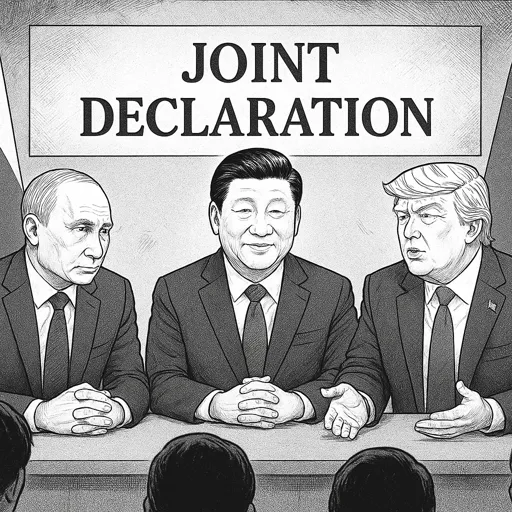
The unprecedented trilateral meeting in Shenzhen produced a joint declaration on stability, nuclear risk reduction and talks on institutional reforms, but stopped short of concrete settlements on Ukraine. Coverage splits between accounts of tangible cooperation and widespread skepticism that the summit was largely a performative photo-op. Observers in Europe and beyond worry the gathering signals a potential reconfiguration of great‑power influence even as the leaders mostly traded broad principles rather than binding commitments. Putin’s post‑summit messaging, and competing narratives from Trump and Xi, leave outcomes uncertain and dependent on follow‑up diplomacy.
Leaders issued a joint declaration committing to international stability, nuclear‑risk measures and talks on institutional reform; Xi presented guiding principles while Trump and Putin endorsed broad cooperation. Reporting emphasizes the summit’s formal outputs—shared language on disarmament and confidence‑building—while noting the lack of binding steps or immediate resolutions on Ukraine.
Many commentators and opposition figures denounced the summit as largely symbolic or propagandistic, arguing it served image‑making more than policy breakthroughs. Critics warned the declaration risks being a farce or a sign of American retreat rather than a durable shift in global governance.
Multiple outlets provided on‑the‑ground chronologies and scene‑setting accounts, describing the venue, key moments, bilateral side meetings and the leaders’ interactions. These pieces frame the meeting as historic in form and consequential in optics, while cataloguing what was said and how events unfolded at APEC.
Analysts place the three‑way meeting in a broader context of potential realignment, comparing it to historical power pivots and warning Europe may be sidelined. Coverage explores how talks on trade, technology and spheres of influence could reshape diplomatic fault lines if follow‑through occurs.
Observers highlight Putin’s prominent role: he framed the summit as a new diplomatic chapter, at times urging compromises on Ukraine while elsewhere issuing bellicose rhetoric about retaliation. Commentators debate whether Putin emerged as a winner in restored stature or whether his statements mask continued strategic ambiguity.