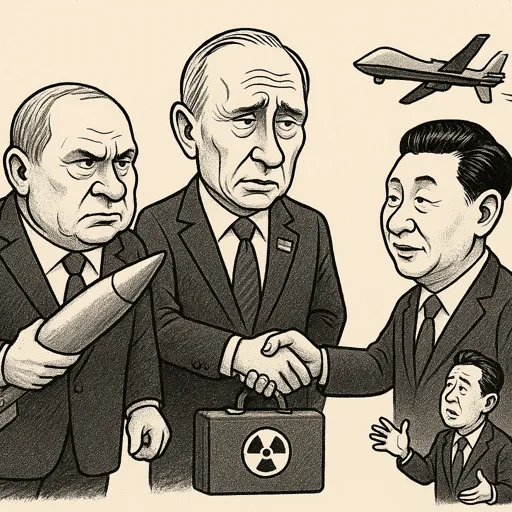
The United States, Russia and China are jockeying for influence through a mix of personal diplomacy, strategic signaling, and material power projection—creating frictions in alliances and regional security. Personal ties and summit theatrics have altered perceptions of U.S. reliability, while Moscow stresses resilience under sanction and Beijing leverages economic and technological reach. Nuclear and advanced-weapons signaling, from briefcases to kamikaze drones, elevates risks and forces allies to reassess deterrence and contingency planning. Smaller states and frontline actors stress agency and warn that summit optics cannot replace local realities in resolving conflicts.
Former President Trump’s public cultivation of personal ties with Xi and Putin reshapes the narrative of great-power competition, creating both openings and anxieties about U.S. reliability. His comments and actions—on friendships, nuclear posture and crisis signalling—have pushed European and regional partners to rethink deterrence and contingency planning.
The Kremlin emphasizes resilience to Western pressure and seeks to sustain influence via military means, media projects and recruitment drives while blaming adversaries for stalemate. Moscow’s public messaging frames sanctions and conflicts as manageable, reinforcing its bargaining posture even as covert and overt operations continue abroad.
Beijing deploys diplomacy, economic ties and technological ambition to expand influence across Asia-Pacific and beyond, recalibrating relationships with partners such as Australia and Singapore. China’s scale in data, AI and integrated economic linkages complicates smaller states’ balancing acts and reshapes strategic calculations in the region.
Great-power rivalry is increasingly visible in hardware: nuclear signaling, strategic aircraft and new-class weapons such as kamikaze drones alter the character of deterrence and battlefield dynamics. These developments are forcing regional militaries and allies to adapt posture and doctrine across multiple theatres, from Europe to Africa and the Indian Ocean.
European and allied responses show rising alarm over covert operations, disinformation and strategic vulnerabilities, leading to public denunciations and intelligence actions. Simultaneously, energy geopolitics and maritime security reveal disjoints between diplomatic pacts and volatile local realities that can be exploited by rivals.
Smaller states and frontline actors emphasize their own agency amid great-power competition: Singapore navigates expectations to preserve autonomy, while Ukrainians insist that sovereignty and on-the-ground realities—not summit optics—will shape outcomes. These voices caution against overreliance on high-level diplomacy to resolve entrenched conflicts.