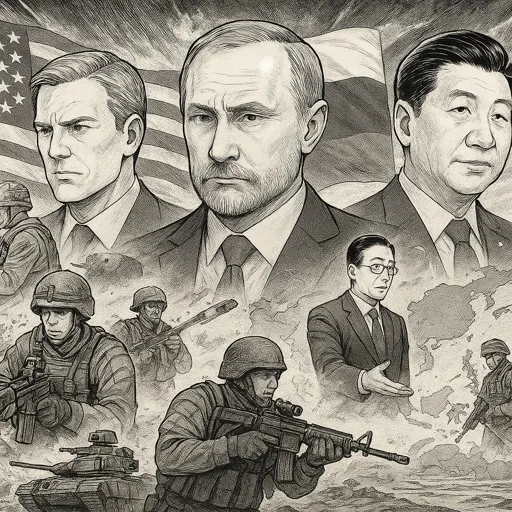
The U.S., Russia and China are competing to redefine global order through military, diplomatic and ideological means, with effects that spill beyond Europe into Africa, the Middle East and the Indo-Pacific. China projects a Yalta-like vision of multipolarity and diplomacy, while Russia leverages kinetic escalation and asymmetric operations to challenge Western influence. Washington and NATO face alliance strains, deterrence dilemmas and novel threats such as space weaponization, driving debates about preparedness and strategy. Regional contests—from the Mozambique Channel to Gulf disputes—show how great power rivalry amplifies local conflicts and complicates security cooperation.
Coverage emphasizes an outward expansion of the Russia–Ukraine war, spotlighting incidents off Libya’s coast and debates in Kyiv about offense as the best defense. Sources portray actions ranging from alleged drone strikes to heated rhetoric between leaders as evidence that the conflict’s footprint and escalation risks are no longer confined to Europe.
European outlets focus on the implications of a shifting conflict outcome for NATO cohesion, national security commitments and crisis escalation risks. Commentators warn that potential losses, shifting guarantees, and even accidental nuclear scenarios require clearer strategy and greater preparedness across allied capitals.
Multiple pieces frame Xi’s diplomacy and a high-profile summit as an effort to institutionalize a multipolar order that sidelines U.S. hegemony, presenting Beijing’s rhetoric of mutual respect and peaceful coexistence as an alternative model. Commentators debate whether this signals a genuine systemic change or a strategic narrative aimed at expanding Chinese influence.
Reporting highlights great power competition in strategic regions and domains—from Russian ambitions in the Indian Ocean and Gulf-area proxy tensions to a broader trio rivalry and anxieties about space-based weapons. The common thread is that regional disputes and technological arms races are arenas where Moscow, Beijing and Washington test influence and shape security architectures.