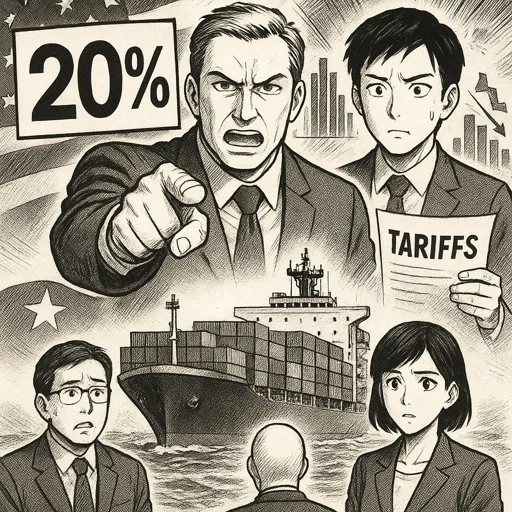
The United States has proposed a new package of tariffs targeting 14 trading partners, with levies up to 20% (notably flagged for Singapore and with China facing the highest proposed rates). Affected governments in Asia and beyond are opening negotiations, seeking exemptions or lower caps while warning of economic and political fallout. Analysts frame the move as a strategic use of presidential authority to address alleged industrial overcapacity and trade imbalances, rather than a measure driven primarily by public popularity. Markets and supply chains face uncertainty as countries weigh retaliation, accommodation, or bilateral talks to limit damage.
Several Asian exporters emphasize negotiation and mitigation: Singapore and South Korea signal talks to lower or limit the impact of proposed levies, while Thailand stresses many goods may escape high ceilings. Japan and India are presented as major targets in U.S. reasoning about excess industrial capacity, prompting affected Asian economies to press for favorable final rates or exemptions. The region highlights both immediate trade risks and strategic adjustments by firms and policymakers.
European and allied voices warn of escalatory consequences, with reporting focused on possible tariffs against the EU, Switzerland and broader transatlantic tensions. Domestic political reactions in EU countries underscore debate over consumer costs and the risk of retaliatory measures. Several national outlets frame Washington’s move as a source of diplomatic strain requiring negotiations or countermeasures.
News outlets worldwide report the broad scope of the U.S. announcement—tariffs affecting China, the EU, Japan and a dozen other partners—and highlight likely impacts on supply chains, import costs and exporters. Coverage centers on the practical outcomes for trade flows and the potential for higher prices and disrupted manufacturing inputs. Some pieces flag the absence of full implementation details and the uncertain short-term market response.
Opinion and analytical pieces interpret the tariffs as a tool of presidential leverage aimed at rebalancing trade and curbing overcapacity rather than courting popularity. Coverage contrasts the administration’s assertive tariff posture with occasional diplomatic moves to ease frictions, underlining a mix of coercion and negotiation in U.S. strategy. Analysts warn that the approach risks political blowback and broader economic side effects.