
France is currently grappling with significant internal political tensions following the murder of a far-right activist, which has sparked large protests and calls for calm from President Macron. Concurrently, France is actively engaged in leading a unified European Union response to new tariffs imposed by the United States, emphasizing diplomatic and economic coordination. Additionally, France continues to show strong public and governmental support for Ukraine amid the ongoing conflict with Russia, demonstrated by multiple large-scale demonstrations and solidarity efforts.
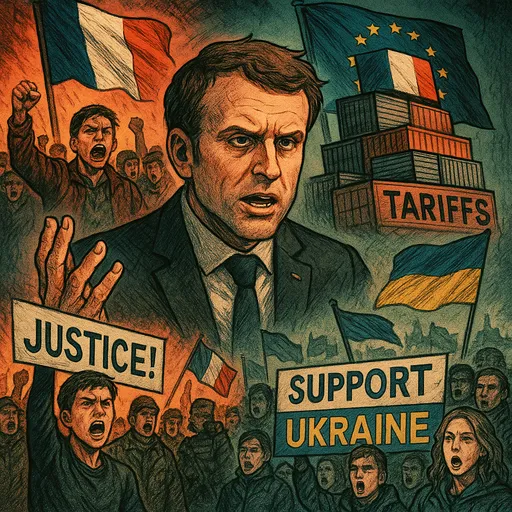
The murder of a far-right activist in France has triggered widespread protests and heightened political tensions across the country, with thousands marching in cities like Paris and Lyon. President Emmanuel Macron has repeatedly called for calm and increased security measures to prevent violence, while authorities investigate the incident and its political implications. The event has also strained diplomatic relations, notably between France and Italy, and attracted international attention including condemnation from the US.
France is at the forefront of efforts to coordinate a unified European Union response to the tariffs imposed by US President Donald Trump, which have escalated transatlantic trade tensions. French leaders, including President Macron and Trade Minister Nicolas Forissier, emphasize that the EU has the necessary tools to counteract these measures through legal and diplomatic channels. Germany and other EU countries are aligned with France in seeking a clear and consolidated strategy to address the economic and political impacts of the tariffs.
France has witnessed numerous large-scale demonstrations expressing solidarity with Ukraine as the war with Russia enters its fourth year. These rallies, held in Paris and other cities, highlight strong public support and calls for continued international aid to Ukraine. The French government and civil society remain actively engaged in supporting Ukraine, reflecting broader European security concerns and humanitarian commitments.
French authorities have charged individuals suspected of financing terrorism under the guise of humanitarian aid, reflecting ongoing vigilance against security threats. The government is also focused on monitoring and managing political violence linked to extremist groups, as seen in the response to the activist's killing and related protests. These efforts underscore France's commitment to maintaining internal security amid complex social and political challenges.
France is strengthening its diplomatic presence and geopolitical influence through initiatives such as opening consulates in Greenland alongside Canada and advocating for a more autonomous European defense posture within NATO. President Macron has called for Europe to become an independent geopolitical power, reducing reliance on external actors. These moves reflect France's strategic ambitions in global affairs and regional security.
French local leaders have expressed concerns about transportation reliability, particularly regarding train services, anticipating difficult months ahead. Additionally, a resolved amber alert case involving a missing baby in Lille highlights ongoing public safety efforts. These domestic issues, while less prominent internationally, affect daily life and governance within France.
Beyond official government support, French citizens have engaged in grassroots humanitarian efforts, such as a baker distributing hot bread to Ukrainians affected by the war. These actions demonstrate the role of civil society in complementing formal aid and maintaining public solidarity with international crises.