
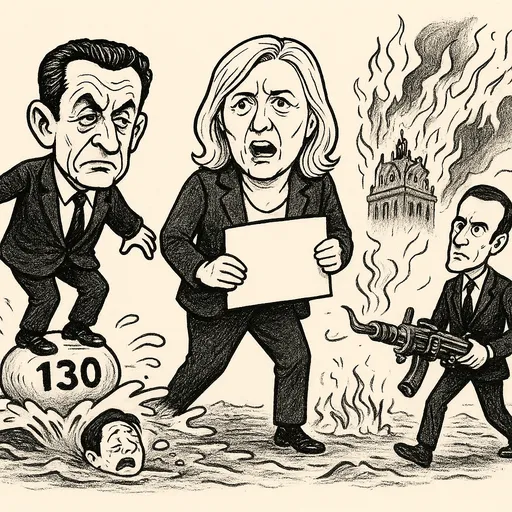
France is currently navigating a complex landscape marked by significant political developments, including former President Sarkozy's ongoing legal battles and Marine Le Pen's confirmed presidential candidacy amid legal controversies. The country is also grappling with a severe heatwave causing over 130 drowning deaths and multiple heat-related fatalities, alongside worsening drought and deadly wildfires. Additionally, France confronts security concerns highlighted by recent bomb attacks during President Macron's visit to Syria and high-profile cultural site robberies, reflecting broader challenges in domestic and international stability.
This cluster focuses on the evolving political scene in France, highlighting former President Nicolas Sarkozy's legal trials and appeals, which continue to attract public and judicial attention. Marine Le Pen's announcement to run for the 2027 presidency, despite her conviction and legal scrutiny, signals a significant shift in the electoral dynamics, with polls positioning her as a frontrunner. The articles also explore the implications of these developments on the French right-wing, the broader political spectrum, and the upcoming presidential race, including the potential candidacy of Christine Lagarde and the impact of populist rhetoric.
France is enduring an intense and deadly heatwave that has resulted in at least 131 drowning deaths and multiple heat-related fatalities, including the tragic death of a young child. The extreme temperatures have exacerbated drought conditions, with rivers drying up and ecosystems under stress, while wildfires have become twice as deadly compared to the previous year. Authorities are actively issuing warnings, implementing cooling measures, and urging public vigilance to mitigate health risks and environmental damage during this prolonged heat event.
Security concerns are prominent with bomb attacks occurring in Damascus during President Emmanuel Macron's visit, underscoring the volatile situation in Syria and the challenges facing French diplomacy in the Middle East. The French government is also addressing domestic security through new legislation authorizing police use of firearms under specific conditions. Additionally, high-profile cultural institutions like the Lalique Museum have suffered significant robberies, raising questions about security measures. France's role in international peace processes and defense, including calls to support the Azerbaijani-Armenian peace efforts and participation in defense expos, further illustrate its active engagement in global security matters.
France continues to foster international cooperation through projects such as the €753,000 plastic recycling initiative in Nigerian universities, promoting environmental sustainability and education. Discussions on education funding reforms at international forums also highlight France's involvement in global development dialogues. These efforts reflect France's commitment to supporting innovation, sustainability, and educational improvements beyond its borders.