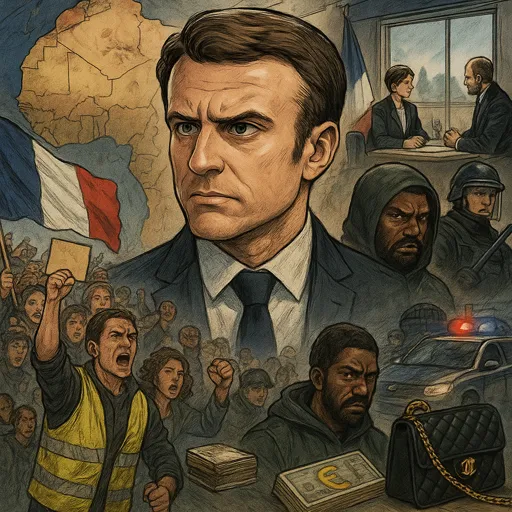
France is actively managing significant domestic challenges, including large-scale protest mobilizations and concerns over internal crime and public safety, while simultaneously engaging deeply in diplomatic efforts ranging from Ukraine peace negotiations to addressing regional security in Africa and Middle East tensions. The country also navigates complex economic and legal issues in the luxury goods sector and handles international disputes involving trade and sovereignty. These multifaceted dynamics reflect France's pivotal role on both the domestic front and the global stage.
France is preparing to deploy approximately 70,000 police and gendarmes to handle anticipated large-scale protests, underscoring ongoing social tensions. Additionally, reports of drug trafficking gangs recruiting teenagers reveal challenges in maintaining public safety, while an Ebola case in metropolitan France highlights health security concerns. The government’s focus remains on law enforcement and safeguarding public order amid these pressures.
France actively participates in multilateral diplomatic initiatives such as Ukraine peace talks alongside Germany, Italy, Poland, the UK, and EU institutions to assert a unified European stance. French officials express concerns about nuclear escalation risks involving Russia, emphasizing the need for clear doctrines to prevent miscalculations. France also addresses espionage accusations against Iran and counters cyberattacks attributed to Tehran, reflecting heightened global security engagements.
Reflecting a strategic shift, France has withdrawn its military bases from the Sahel and West Africa to restructure overseas deployments. French defense officials encourage Ethiopia's involvement in regional maritime security initiatives in the Red Sea, promoting dialogue for stability. Furthermore, bilateral engagements with countries like Guinea Ecuatorial and Mozambique emphasize France’s continued diplomatic presence and interest in African security and development.
The luxury sector faces turbulence with a €9 billion disappearance of Hermès shares involving LVMH and Bernard Arnault, raising legal and market concerns. Concurrently, France urges the European Commission to investigate possible trade barriers imposed by Algeria against French products, highlighting ongoing commercial disputes. These economic challenges reveal the intersection of corporate governance and international trade tensions for France.
French domestic politics sees figures like Olympic judoka Teddy Riner advocating for healthcare priorities, while former President Sarkozy confronts campaign funding allegations amid legal proceedings. France refuses to ban a contentious exhibition regarding settlements in East Jerusalem, reflecting complex international cultural-political debates. On the environmental front, France strengthens development partnerships with Ethiopia ahead of COP32 and fosters regional diplomacy in the Middle East through discussions involving Egypt and Kuwait.
France continues to deepen bilateral relationships through ambassadorial engagement, exemplified by new envoys to Vanuatu and media cooperation initiatives in Laos. These efforts underscore France's commitment to regional environmental cooperation and fostering closer cultural and informational ties beyond Europe.
Bomb threats led to the evacuation of schools in France and Italy, revealing heightened security vigilance across Europe. These precautionary measures reflect ongoing concerns about public safety and the potential for destabilizing incidents within the region.
Ongoing sovereignty disputes persist, illustrated by Vanuatu initiating legal cases against France over Mathew and Hunter Islands. These actions indicate unresolved international legal challenges for France and its engagement in global territorial issues.
Data from French supermarkets and hospitality sectors reportedly shocked France, characterizing the influx of Italians as an 'invasion'. This sensational depiction points to evolving cross-border social interactions and economic impacts potentially influenced by tourism or migration patterns.
In Morocco, the CGEM awarded a CSR label to Lesieur and Safran Aircraft Engine Services, reflecting regional emphasis on corporate social responsibility and collaborative efforts between Moroccan and multinational companies.