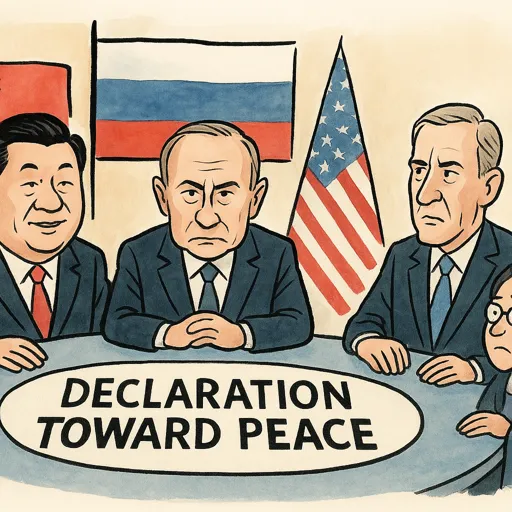
The Shenzhen trilateral summit yielded a joint ‘Declaration Toward Peace’ that emphasizes nuclear risk reduction, strategic stability, UN reform and cooperation on energy, while signaling renewed high-level dialogue among Washington, Beijing and Moscow. Reactions are sharply divided: Chinese and sympathetic voices portray the meeting as historic and a step toward a multipolar order, whereas many Western analysts see a limited, possibly performative pact lacking firm, verifiable commitments. European and Ukrainian responses highlight concern over Russian influence and push for broader involvement in any peace negotiations. Overall, the summit marks intensified three-way engagement but leaves the durability and concrete implementation of its proposals uncertain.
Official reporting and primary documents emphasize a signed declaration committing the three powers to de‑escalation, nuclear risk reduction, strategic stability and proposed UN reform, while noting talks on energy supply. Coverage stresses the diplomatic milestone of a trilateral communique but repeatedly notes few immediate, concrete steps detailed in the text.
State and sympathetic commentaries frame the summit as unprecedented and historic, arguing it advances a multipolar order and promotes cooperation built on respect for sovereignty. Chinese leaders’ stated principles and supportive editorials present the meeting as constructive diplomacy focused on peace and stable great‑power relations.
Coverage focused on the U.S. angle highlights President Trump’s defense and promotion of his personal ties with Xi and Putin, portraying those relationships as central to managing competition and advancing talks. Journalists note Trump’s public optimism alongside acknowledgements that arms‑control limits with China and Russia will be difficult to achieve and that domestic politics shape follow‑up plans.
Western analysts and commentators frequently dismiss visions of a new Yalta, labeling the summit a ‘fake Yalta’ and warning that divergent national situations limit durable cooperation. Broader analytical pieces stress multiple competing visions and caution that rhetoric may outpace verifiable policy outcomes.
European leaders and Kyiv reacted skeptically and proactively—some officials said the declaration included Ukraine, while others pushed for Europe’s direct participation in negotiations. Ukrainian leaders criticized conciliatory tones toward Russia, and coverage highlights efforts to involve Germany, France and other partners in follow‑on diplomacy.
Regional commentary situates the trilateral meeting within the broader APEC context, stressing Shenzhen’s role as an economic and diplomatic hub and the summit’s potential to shape Asia‑Pacific cooperation. Reporting also flags concerns from allies—especially Japan—that shifting alignments could test rule‑of‑law diplomacy and alliance commitments.