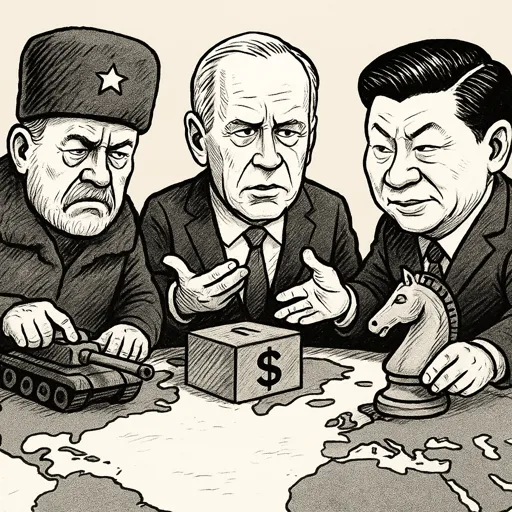
Great power competition is reshaping security across Europe, Africa and the Indo-Pacific as the US, Russia and China project military, diplomatic and informational power. Russia’s military buildups near NATO borders and its activities in Africa and the Middle East test alliance cohesion and risk regional spillover, while Western military aid to Ukraine is both strengthening Kyiv and strained by domestic political fatigue. Perceptions of US weakness under changing leadership encourage strategic opportunism by rivals, and China’s mix of partnerships and pressure tactics is reshaping influence in the Pacific and beyond. Local conflicts are increasingly arenas for strategic signaling and proxy competition, complicating efforts to stabilize regional orders.
Satellite imagery and reporting depict a concentrated Russian military buildup along NATO frontiers, sparking concern about escalation and prompting rearmament measures. Analysts read these moves as strategic signaling intended to deter NATO and influence alliance politics.
Residents and officials in the Baltic states increasingly fear spillover from the Ukraine war as incidents and rhetoric bring the conflict closer to home. Political leaders predict turning points and call for strengthened NATO readiness, reflecting anxiety about deterrence and alliance credibility.
Deliveries such as Germany’s KF41 Lynx IFVs visibly strengthen Ukraine’s battlefield capabilities and signal continued Western commitment. At the same time, waning public support and political doubts in key allies threaten sustained aid, complicating long-term strategy.
Reporting highlights Russia’s investments and losses across Africa and Libya, with leaks and incidents illustrating the human and material costs of Moscow’s ambitions. European actors, notably France, are responding to counter Russian influence in the Indian Ocean and North Africa, turning these regions into competitive arenas with risks of wider spillover.
Moscow and its partners exploit diplomatic events, media and political openings to shape international perceptions, while shifts in US credibility are seen as invitations by rivals to press advantage. Rhetoric from regional leaders and political actors further polarizes narratives about who is gaining ground, complicating de-escalation efforts.
Observers portray China as cultivating a mix of genuine allies and more dependent partners to expand influence, raising concerns about sovereignty and alignment. Critics warn that heavy-handed diplomacy by democracies, if misapplied, could push Pacific states closer to Beijing and intensify strategic competition in the region.